
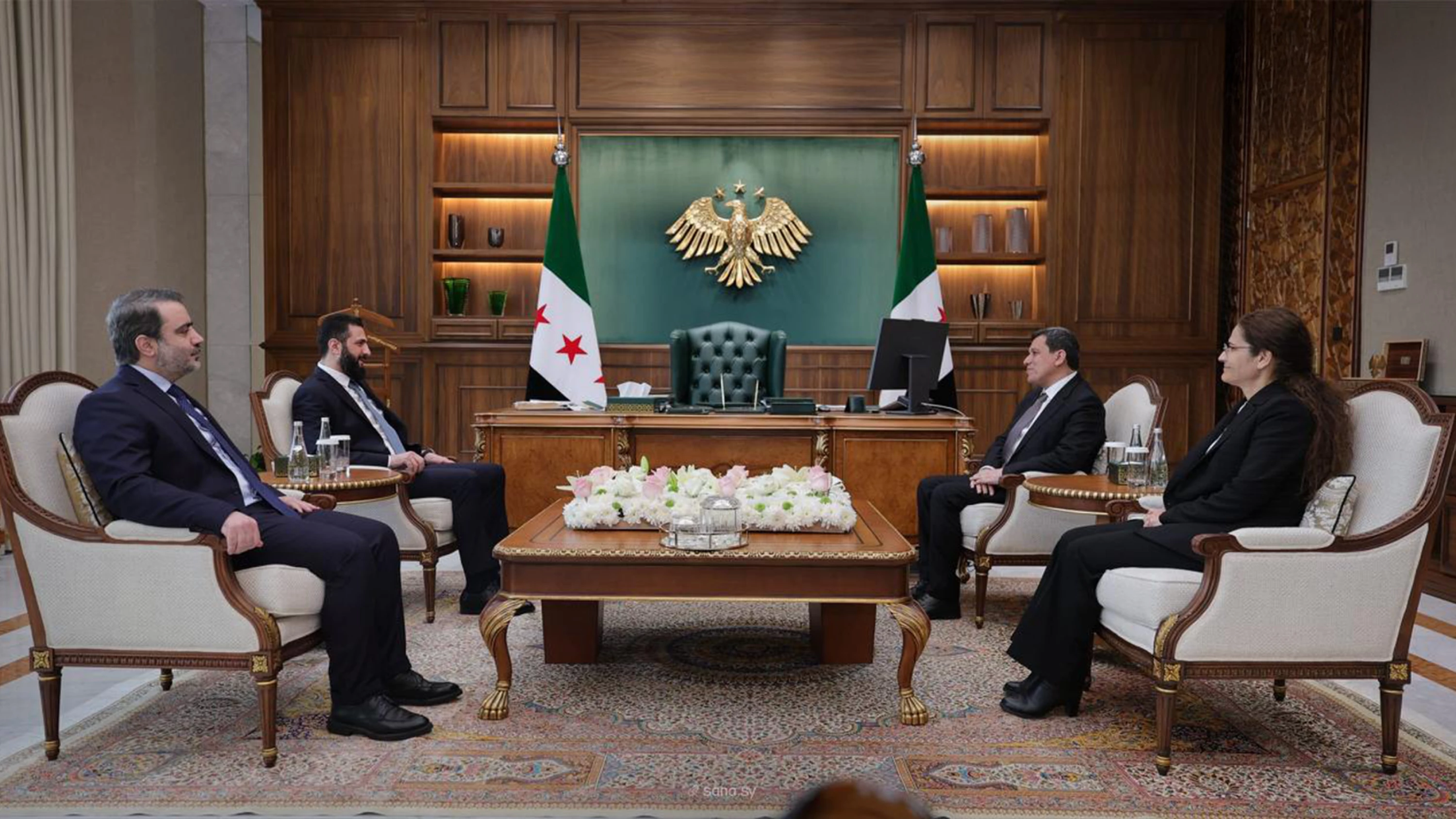
ERBIL, Kurdistan Region of Iraq – Syria’s interim President Ahmed al-Sharaa on Thursday received a high-level delegation from Rojava (northeast Syria) headed by Syrian Democratic Forces (SDF) chief Mazloum Abdi to discuss “completing the integration process” between Rojava and Damascus, state media reported.
Abdi and the Rojava administration’s foreign relations co-chair Elham Ahmad were received by Sharaa, Foreign Minister Asaad al-Shaibani, and presidential envoy Ziad al-Ayesh in Damascus, Syrian state media reported.
The meeting was held to discuss further steps toward “completing the integration process in state institutions” under the January agreement between the SDF and Damascus.
On January 29, SDF announced that it had reached a “comprehensive agreement” with Damascus to enable a phased integration process of the Kurdish-led forces into the Syrian state after weeks-long clashes.
The agreement came after a Damascus offensive against Rojava that spanned the better part of January, in a bid to secure Sharaa’s vision of a united, centralized Syria, despite the country’s marginalized minorities repeatedly calling for federalism.
Before the Thursday meeting, a lengthy meeting was held with Syrian officials, including Shaibani, in which “several key issues were discussed in depth,” Ahmed al-Hilali, head of the Syrian monitoring team for the January agreement, said, as cited by state media.
“The issue of the return of refugees and internally displaced persons topped the agenda,” he said, adding that the “integration process and its implementation mechanisms” were also discussed.
Three convoys of around 800 displaced families from the Kurdish city of Afrin in northern Syria and nearby areas returned to their hometowns earlier this week in a move that comes as part of the implementation of the January ceasefire.
The January deal led to a ceasefire that saw Syrian government forces enter Kurdish-held areas, the appointment of a Kurdish mayor in Hasaka, and other key roles granted to the Kurdish-led Autonomous Administration, ongoing efforts to return IDPs from Afrin and Sari Kani (Ras al-Ain) to their hometowns, and the exchange of prisoners.
The Rojava administration in late January said that the offensive by Damascus-affiliated factions had displaced at least 350,000 people toward Hasaka, Qamishli, and Kobane, from Raqqa, Tabqa, and Deir ez-Zor.
 Facebook
 LinkedIn
 Telegram
 X
X