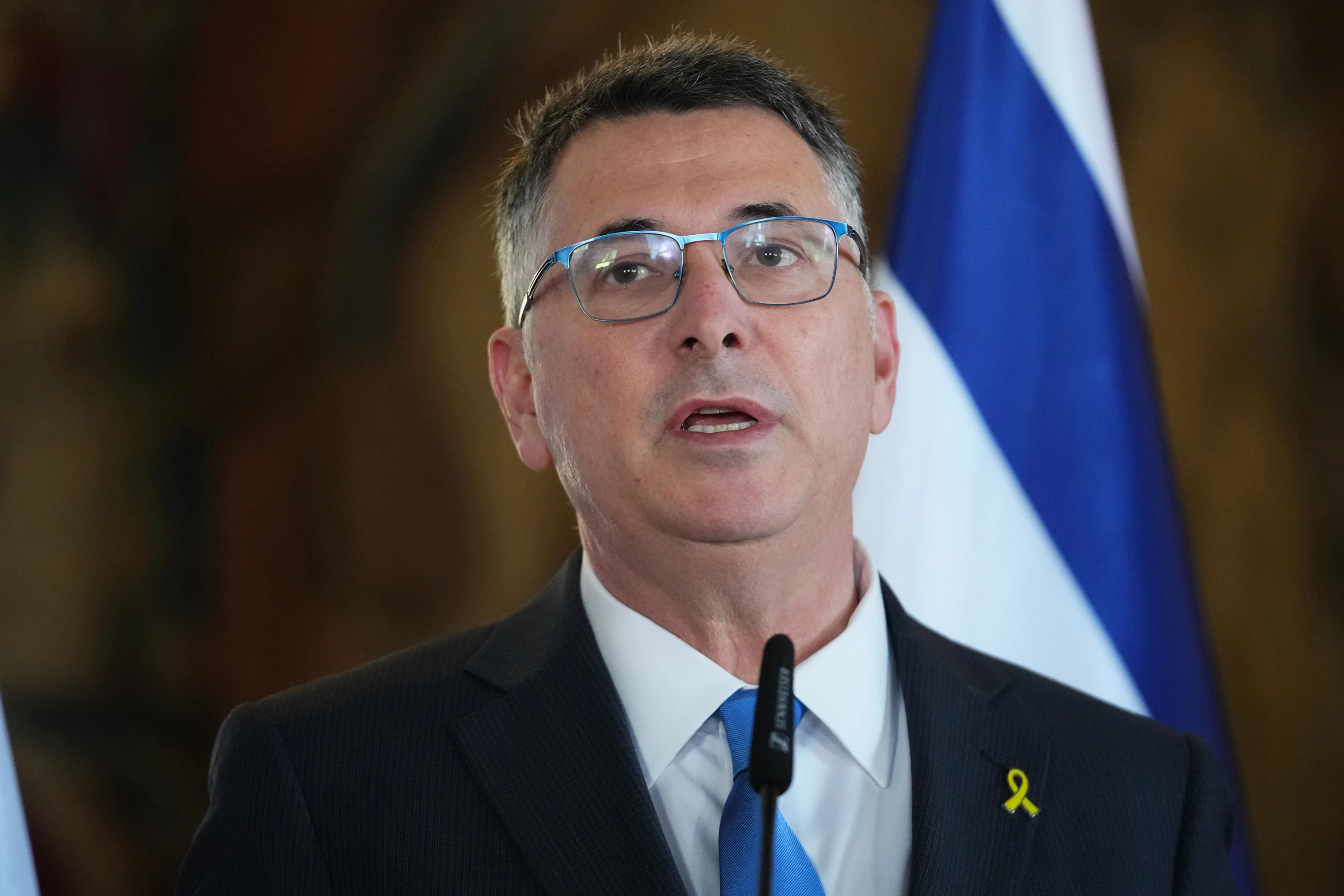
ERBIL, Kurdistan Region of Iraq - Israeli Foreign Minister Gideon Saar on Monday criticized the European Union for political “dictates” toward Israel, coming after he announced cutting off contact with EU foreign policy Kaja Kallas for reportedly comparing Israel's treatment of Palestinians to “apartheid.”
Saar's remarks came during a meeting with EU Commissioner for the Mediterranean Dubravka Suica to discuss Europe-Israel relations, with the latter stressing that “partnerships require open and honest dialogue.”
While labeling Israel “a democratic and progressive country,” Saar claimed that EU-Israel ties “are important to both of us,” adding that “Europe has common interests and significant and comprehensive cooperation with Israel."
“We believe in the importance of a sincere, comprehensive, and open dialogue with the European Union,” Saar stated, as quoted by Israeli state media. “But there can be no dialogue when one side dictates its political views to the other. Certainly not when it comes to fundamental issues that are at the core of our existence.”
Although neither of the two made any direct reference to Kallas during the brief press appearance, Saar’s remarks appeared to many as a direct reference to the EU foreign policy chief, who reportedly compared Israel’s genocide and violence on Palestinians to South Africa’s apartheid regime in private remarks to EU officials during a trip to Mexico last month.
Saar responded that he had “no choice but to sever all contact” with Kallas until she offered an explanation, yet she only stated that she valued “dialogue and engagement” and a “constructive relationship” with Israel, notably avoiding any mention of the alleged apartheid comment.
“To bring peace to the Middle East, the two-state solution remains the only viable path. The EU has condemned the illegal Israeli settlements in the West Bank that make it increasingly difficult to get to that goal. That is the EU position,” Kallas would later write on X in a reply to Saar's comments.
Last September, 142 countries voted in favor of a two-state solution at the United Nations General Assembly. Israel, Argentina, Hungary, Micronesia, Nauru, Palau, Papua New Guinea, Paraguay, Tonga, and the United States voted against it, while 12 nations abstained.
Saar also reiterated his nationalist far-right government’s stance on Israeli settlements, citing “the Jewish people's historic right to live in the territory,” despite the EU imposing sanctions last month on seven Israeli settlers and affiliated entities over their "systematic violence" against Palestinians and the expansion of illegal settlements in the occupied West Bank.
In the wake of Israel’s genocide in Gaza and the expansion of settlements in the occupied West Bank – which are deemed illegal under international law – many EU citizens have spoken out against the bloc’s ties to Tel Aviv, with an online petition calling for a formal break in relations with Israel.
More than 500,000 Israeli settlers now live in communities scattered across the West Bank, territory Israel has occupied since 1967. These settlements are deemed illegal under international law.
An EU diplomat, speaking anonymously to Euronews on Monday, reportedly criticized Suica for failing to address “the boycott of her colleague.”
During the same trip, Suica is also expected to meet with Israeli President Isaac Herzog, as well as Palestinian Vice President Hussein al-Sheikh and Prime Minister Mohammad Mustafa in the occupied West Bank.
 Facebook
 LinkedIn
 Telegram
 X
X