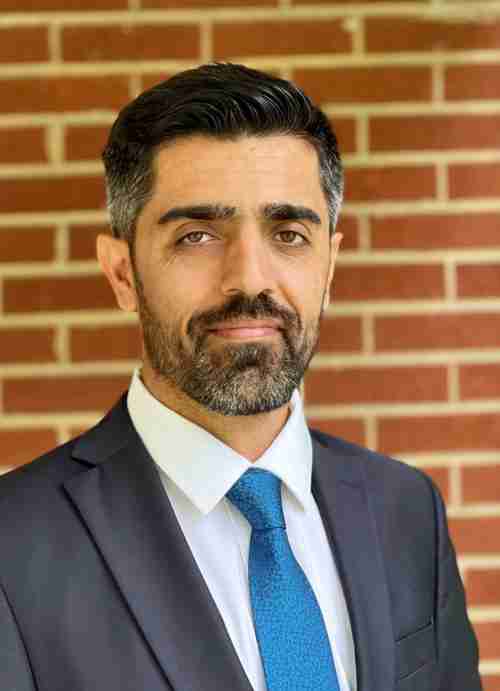
In the latest episode of The New Region's GeoSpace podcast, host Mohammed A. Salih sits down with Dr. Mohammed Shareef, Kurdish scholar and political analyst specializing in US foreign policy toward Iraq and the Kurdistan region, to discuss Prime Minister Ali al-Zaidi's visit to Washington, the prospects for militia disarmament, and what a warming Baghdad-Washington relationship means for the Kurdistan region.
Shareef described the visit, which produced 48 memoranda of understanding (MoU) reportedly worth around $60 billion, as "the beginning of a transition from a military security relationship to an economic partnership." For the Trump administration, he argued, this shift is "absolutely crucial, something that comes first and foremost in their thinking."
On the ambitious domestic agenda Zaidi has put forward — fighting corruption, attracting foreign investment, and bringing armed factions under state control — Shareef argued that circumstances have changed in ways that give the new prime minister an opportunity his predecessors lacked. Washington appears firmly behind Zaidi, and both Iraq’s supreme religious authority, led by Grand Ayatollah Ali al-Sistani, and prominent Shiite cleric Muqtada al-Sadr are generally opposed to the Iran-backed factions and armed groups operating outside the control of the state. "He has US support, support from the Marja’ and Sadr domestically," Shareef said. "I think he's in a very good position to be able to implement."
Still, he cautioned that resistance is inevitable. "Al-Zaidi is between a rock and a hard place," he said, noting that the resistance groups within the Popular Mobilization Forces are unlikely to voluntarily surrender their heavy weaponry, and that the coordination framework will not welcome a political newcomer consolidating power. He added that while Zaidi's recent arrests of senior figures – as part of the country’s recent anti-corruption campaign – were a signal of intent, "they were not really the big fish."
On the broader question of whether the militia issue could be sidestepped — as some have suggested by drawing parallels with the US acceptance of Ahmad al-Sharaa in Syria — Shareef argued the situations differ. Iranian proxies, he said, have drawn a different lesson from Syria's transition: that they are "no longer welcome" in the new Middle East, and that the path forward lies in transitioning toward political participation rather than armed resistance.
Turning to the Kurdistan Region, Shareef was candid about the risks posed by a stronger Baghdad-Washington axis. "The place of the Iraqi Kurds in US foreign policy is renegotiated all the time," he said, identifying three variables that shape it: developments in Baghdad, US regional alliances, and Washington's long-term vision for the Persian Gulf. "Whenever US relations with Baghdad strengthen, it usually means that US relations with the Kurdistan region weaken," he said.
To maintain their significance, Shareef urged Kurdish leaders to prioritize democratic reform, fight corruption, form the long-delayed tenth cabinet, hold parliamentary sessions, unify the Peshmerga, and diversify the economy. "The more Kurdistan becomes democratic and institutionalized, the more the United States would be happy," he said.
Shareef remained cautiously optimistic about the Kurds' long-term value to Washington. "With the Kurds, promises are made, promises are kept," he said. "You have both the governments and the people supportive and friendly towards the United States. The United States values this a lot."
 Facebook
 LinkedIn
 Telegram
 X
X