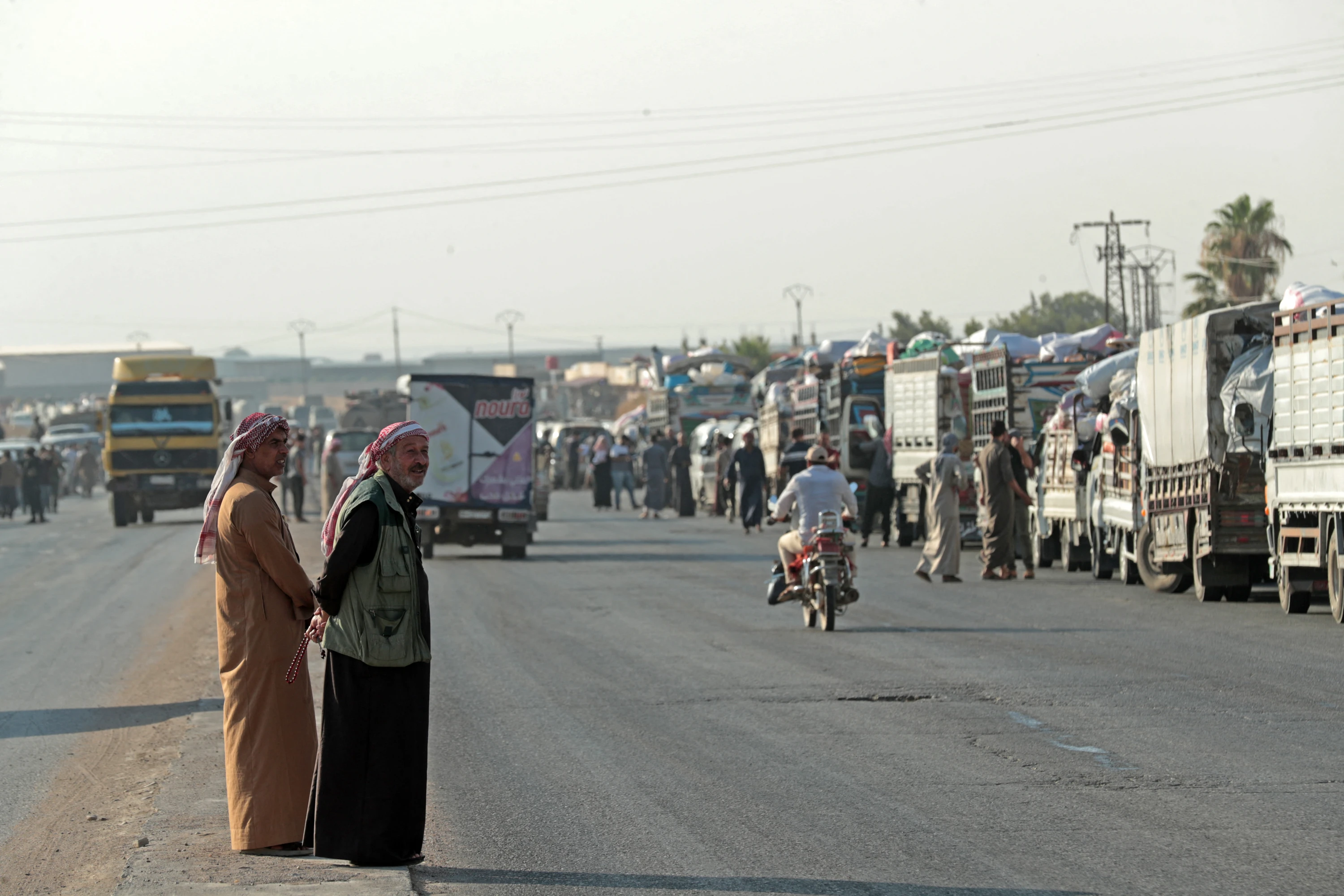
ERBIL, Kurdistan Region of Iraq - On Monday, after seven years of displacement, more than 400 Kurdish families attempted to return to the border town of Sari Kani (Ras al-Ayn) from Hasaka’s Washokani camp as part of the agreement between the Syrian Democratic Forces (SDF) and Damascus, but were attacked by gunmen opposed to their return, sparking heavy tensions.
“The convoy was around 650 households, and around 100 vehicles also passed through with them. The people who were attacked were not part of the convoy,” Salah (44), who was in the convoy, told The New Region.
He added that he was attacked by three people with sticks and weapons, but managed to leave. “Thank God, we are safe, alive, and have our belongings. We got out and came to Hasaka.”
“Those people who attacked us were from Deir [ez-Zor], people from Hasaka, Ghwayran, Aziziyah [two neighborhoods in Hasaka]. They were saying, ‘We don't accept any Kurd in this city.’
Salah also said that there are still people missing after the attack or being treated in hospitals. “There are many people whose whereabouts are unknown. Some are in critical condition, some are wounded, some are in hospital.”
Hasaka’s Internal Security Forces Command told the Syrian state channel Al-Ikhbariya that “the Internal Security Forces intervened to disperse a dispute in the city of Ras al-Ayn following the return of several families to their homes without prior coordination, which led to a dispute with the residents currently living there.”
The security source denied reports that displaced families from Ghwayran neighborhood in Hasaka intervened to prevent the returnees from entering their homes. “The relevant authorities are handling the incident in accordance with legal procedures, ensuring the rights of the returnees while safeguarding the safety of all citizens.”
Public outcry
After the incident, angry Kurdish youths gathered outside the Internal Security Forces building in Hasaka, where a member of the security forces took down the Syrian flag at the protesters’ request. There were also unconfirmed reports that Arab tribes in Deir ez-Zor were mobilizing fighters to travel to Hasaka city.
SDF chief Mazloum Abdi on X condemned the "assault" displaced Kurdish families were subjected to, vowing to hold accountable the perpetrators and to protect returnees.
"We understand the angry reactions in the Kurdish street in response to this assault, and at the same time, we call on our people to exercise self-restraint, refrain from being drawn into any irresponsible acts," he wrote on X.
Nevertheless, Kurdish protests continued, and in Kobane, a Syrian flag at the Internal Security Forces building was taken down by angry Kurdish protestors who also removed a government banner at the district director's building in the city.
Settlers and refugees: A painful history
The mixed Arab-Kurdish town of Sari Kani was captured by the Turkish army and Turkish-backed Syrian National Army in October 2019, displacing thousands of Syrian Kurds and Arabs.
According to UN data, there are 16,352 internally displaced persons (IDPs), including both Arabs and Kurds, mostly from Sari Kani, living in the Washokani Camp in the town of Tuwaynah, northern Hasaka.
As part of the January 29, 2026 agreement between the Syrian government and the SDF, IDPs from both Kurdish and Arab communities should return home. In May, 1,300 families from Afrin also returned to their homes from Hasaka displaced by the Turkish government offensive in March 2018.
On August 5, Hasaka Governor Noureddin Issa Ahmed met with a delegation of residents from Sari Kani to prepare the steps for their return.
Bassam al-Ahmad, a human rights activist and the director of Syrians for Truth and Justice, told The New Region that so far it is unclear if the attacks on returnees were carried out by gunmen linked to armed groups.
“At the same time, these kinds of attacks are raising many questions about the responsibility of the government and the responsibility of the Autonomous Administration,” he said. “Why was there no kind of coordination between them? Why were there no Asayish or Internal Security Forces?”
Ahmad underlined that there should be an investigation to know what happened and who was involved. “This raises many concerns about who is controlling that area. Does it belong to the government in Damascus, or are these just illegal armed groups backed by Turkey?”
“The Syrian government should give them full protection and ensure that they can return and take back their properties. They should ensure their safety. As you know, these are the principles for the return of IDPs: voluntary, dignified, and safe. So this is a violation of one of the main principles regarding the return of IDPs — the issue of safety.”
Hisham Arafat, a Syrian Kurdish journalist from Sari Kani, who left for the Netherlands after the town was occupied by Turkish-backed groups in 2019, told The New Region that the armed arrivals brought their families with them.
“Some of these fighters settled in the area with their families, and many are still living in Ras al-Ayn today. They took the empty Kurdish homes, the shops, and the farmland.”
“For seven years, these settlers built their lives on our property. For them, our return means losing everything they took. So they meet us with stones and sticks. My relatives and acquaintances who were with the convoy told me the same thing today: the settlers shouted that the city belongs to them now, and that they will never leave.”
“A joint letter sent to the UN in July 2026 confirmed that there is still no independent mechanism to verify ownership, cancel forced transactions, or return property to its owners — so everything depends on power on the ground, not on law. When there is no law, the settlers believe that violence can keep the city for them,” he added.
Also on Monday, video footage showed armed gunmen in the streets of Sari Kani apparently intended as a message of intimidation to discourage Kurds from returning.
Earlier on July 22, a convoy of the Hasaka governor and the province's Internal Security Chief, was reportedly pelted with stones by an angry crowd during an official visit to Sari Kani to reactivate the Alouk Water Station, which was been offline since Turkish-backed groups took the town in 2019.
“If they attack the governor, of course they will attack unarmed returning families. And this hostility is not new: many of these fighters came from the Ghweran neighborhood in Hasaka and from Deir ez-Zor, and their factions first tried to take Ras al-Ayn in 2012–2013, when Kurdish fighters expelled al-Nusra Front and other jihadist groups from the town and the border crossing after heavy fighting,” Arafat said. “In 2019 they returned behind Turkish tanks, and today they say the city is theirs.”
Alexander McKeever, a Damascus-based researcher covering northern Syria, told The New Region that the town is a flashpoint for tensions, as are areas such as Sheikh Maqsoud in Aleppo, Kobane, and Azaz-Afrin, where communal tensions have persisted between local communities since the Syrian Civil War.
“Ras al-Ayn is a particular hotspot given that there are large numbers of displaced people from Hasakah City who are either afraid or refuse to return to the city, particularly to the southern neighborhoods of Gweiran and Al-Nashwa, given that the SDF is still nominally in control of these areas.”
Last week, displaced Arab residents from the Arab neighborhoods of Gweiran and Aziziyah visited Hasaka city to prepare for their return.
“I also think this is related to the fact that the integration talks have really been an elite project, where all negotiations are occurring at a high level in Damascus and within the SDF, with very little public discussion or public input on either side. So you have people on both sides, ordinary people who don't really know what's going on and are resentful of certain things that have taken place during the integration process—particularly on the Arab side, the roles being given to SDF figures, and then on the Kurdish side, simply the idea of coming under full Damascus control, which is what's going to happen when integration is implemented.”
The Deputy Director of General Security for Hasakah province Mehmud Xelil on Monday announced on X that the Internal Security Forces arrested a number of those involved and that operations to pursue and investigate other participants are continuing.
“We stress that there will be no tolerance for any party seeking to exploit the current circumstances to spread chaos. Return convoys to the city have also been temporarily suspended as a precautionary measure to ensure the safety of residents, and will resume as soon as the situation stabilizes and full protection for returnees is ensured.”
However, Salah said that IDPs from Sari Kani are unlikely to return. “Based on the attacks we witnessed, it is difficult to return, especially if there are no guarantees.”
Hisham Arafat, the journalist who fled to the Netherlands, noted that “up to now there has been no permanent return of any displaced person to Sari Kani city itself — even individuals who went back left again because of destruction, looted homes, and lack of security,”
“Today was supposed to break that pattern. Instead, the settlers’ violence proved exactly why more than 100,000 displaced people from Sari Kani and its countryside are still waiting in camps and in the cities of the Jazira region,” he concluded.
 Facebook
 LinkedIn
 Telegram
 X
X