
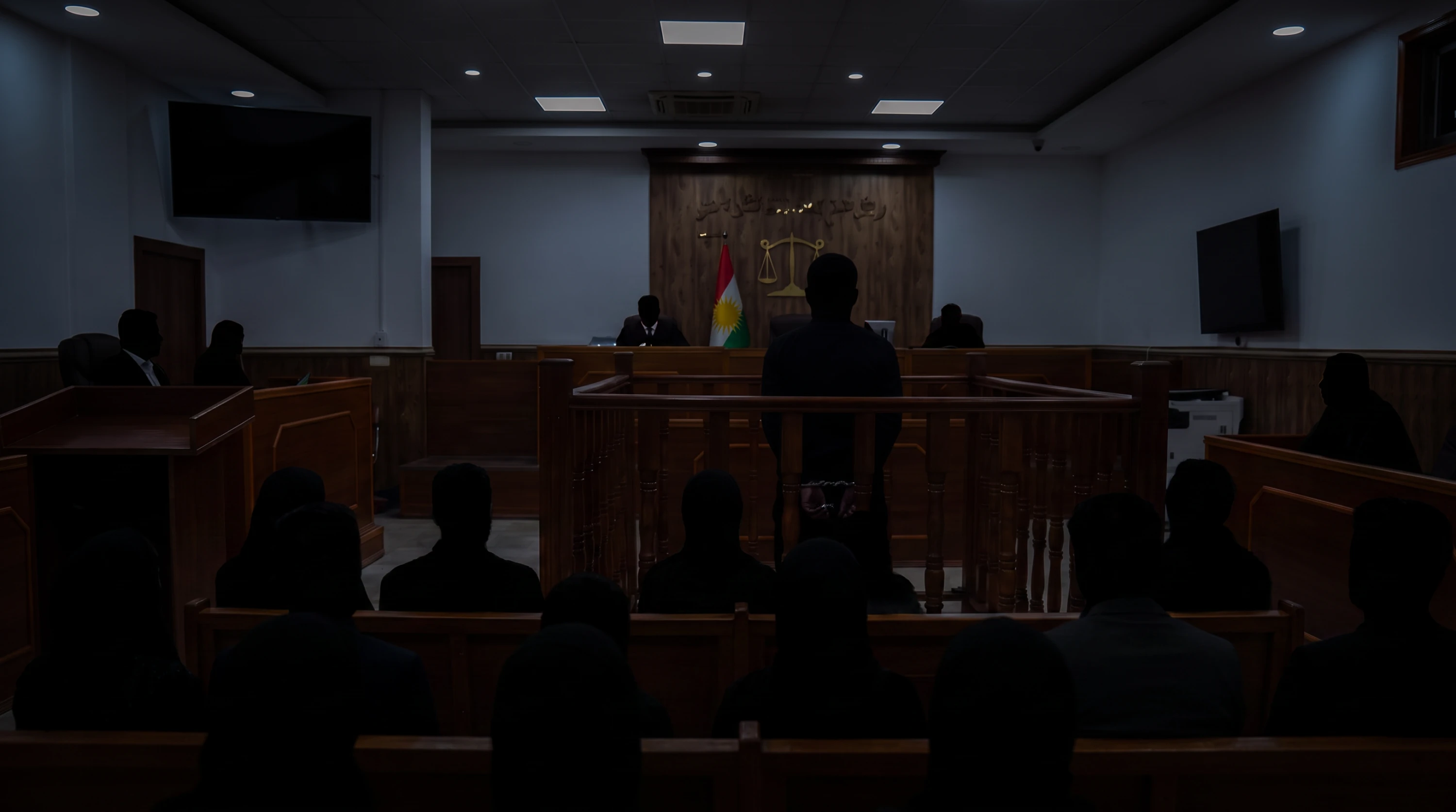
SULAIMANI, Kurdistan Region of Iraq - As Ramadhan was called on to the stand of Sulaimani’s courthouse on Thursday, he scanned the warm courtroom, his shaky hands and anxious posture noticable to all present in for the proceedings. Across the room, he saw his daughter, who had been diagnosed with cancer before his arrest. With a quick sigh, he gathered himself and forced out a smile, a small gesture that defied the ominous circumstances he found himself immersed in.
Ramadhan was the fifth of six people who were called to the stand on Thursday as Sulaimani’s court held the first proper session for the case of opposition leader Lahur Sheikh Jangi and his associates in over a year. Previous sessions had been adjourned time and again.
When asked for testimony, Ramadhan could not bear to have his ill daughter witness the tragedy that had befallen her father. He asked the court to allow his daughter to leave the court room. She was escorted out by Jangi’s niece, crying on her way out.
Seeing this, Ramadhan was shattered - with one hand clasping the edge of the cage tightly, he was shaking. He was ashamed to recount the torture and abuse he had faced during his year in detention, at least not in front of the courtroom filled with people he knew.
By then, many in the courtroom were shedding tears to see Ramadhan in this state, including three attendees whose recollections were used to write this article. Once a strong man, a personal guard to Jangi, now barely standing, barely speaking. He asked that his testimony be in writing, on a paper he handed to the judge, leaving the attendees to their imagination.
Ramadhan was not the first of dozens of detainees arrested on August 22, 2025, to recollect torture in front of a court.
In May, Hama Rash, who served as a bodyguard in opposition leader Lahur Sheikh Jangi's entourage, told the court in Sulaimani that he was subjected to genital torture and extensive physical abuse during his detention.
READ MORE: Lalezar inmate tells court of severe torture, forced confessions
Thursday’s hearing was for Lahur Sheikh Jangi, his brother Polad, and ten other detainees, all accused under Article 56 of Iraq’s Penal Code , which punishes criminal conspiracy.
The dozen men, one merely a gardner, along with others have been arrested for over a year, without due legal process.
Their lawyers have proposed to transfer the hearing to a different court 12 times in the past year, which they define as a right under article 142 of the Iraqi Criminal Procedure Law, which oftentimes requires proof of possible bias or a risk to the safety of the detainees.
The defendants’ lawyers have time and again made claims of the court’s “bias” as the grounds for the transfer motion, the defense team told The New Region. Sulaimani is the Patriotic Union of Kurdistan (PUK) stronghold, whose leader Bafel Talabani, the Jangis’ cousin, is accusing them of conspiring to murder him.
The circumstances under which the Jangi brothers and their aides were arrested, which saw security forces in Sulaimani mount a dramatic, psuedo-military operation, have already raised questions from rights groups. To bring tanks and artillery into the midst of the densely-populated city was, until that August night, something Kurds had vowed to not do to each other for decades.
READ MORE: Battle of Lalezar: Cousins' feud takes toll on Kurdistan's culture capital
However, the court at the beginning of Thursday’s over three-hour-long session denied the motion, eyewitnesses told The New Region.
The Jangi brothers are both British-Iraqi dual citizens.
“We are supporting two British men detained in the Kurdistan Region of Iraq and are in contact with the local authorities,” the British Consulate told The New Region on Thursday. “We continue to monitor the case closely,” but they had no representation at court earlier in the day.
The court didn’t take the two brothers' testimony either. Set up on Thursday, the end of the week in the Kurdistan Region, the court generally does not see cases in the afternoon. Out of twelve men set to testify, only six were called on.
“We are set to receive a notice of the next trial date on Sunday,” Dana Taqiadeen, head of the defense team, told The New Region shortly after the trial.
“Testimonies were taken from six defendants by three judges, and they all said that their previous confessions were derived under duress," Taqiadeen said.
Ramadhan’s turn in front of the court did turn emotions in the room to boiling point. By then, lawyers, judges, family, and friends had sat in front of men away from them for over a year.
First came Botan, he had been identified in “evidence” published by the PUK-affiliated Kurdistan Region Security Agency (Asayish) days after Jangi’s arrest, a seven-page document implicating Jangi in an assassination attempt against PUK leader Bafel Talabani. The Asayish document, which cited statements from the apprehended individuals from the Lalezar gunfight, as well as the agency’s own investigative efforts, outlines that the opposition leader has been implicated in “attempting to target and terrorize the leader of the PUK.”
The report further accuses the opposition leader of engaging in efforts to sow "chaos and unrest through threatening security forces and scaring civilians and government workers.”
Footage of the confessions was also published in addition to the document. The New Region has not been able to independently ascertain the circumstances under which the confessions were acquired.
However, Botan on Thursday told the court that a bag he was seen carrying in CCTV footage from the agency's report had contained tools they had used for Jangi’s earlier election campaign, contrary to the claim of weapons.
“He later chose to address the court through writing about the treatment he had received in detention,” one eyewitness said.
The next two were Sarbast and Kaiwan. Kaiwan was only a gardner at the house of Jangi’s brother, yet he was detained for over a year. Both had denied any involvement.
The fourth man, Aras, told the court that he had been kept in solitary confinement for two months. A small room he defined as a “bird’s nest”, one of the attendees said.
The defense described the Thursday court session as “positive”. It was, after all, the first time some of the defendants were allowed to testify again in front of a court of law, still behind closed doors, but not in a torture room.
They told The New Region that they “demand the rule of law, and hence refuse to accept all accusations against their clients.”
The court’s decision on Sunday may be to hold another hearing next week, or any other date, but, for those who, if they are to be believed, have faced a year of detention in appalling conditions and the omnipresent fear of abuse, every day of delay marks merely another continuation of an unending affront to justice.
 Facebook
 LinkedIn
 Telegram
 X
X