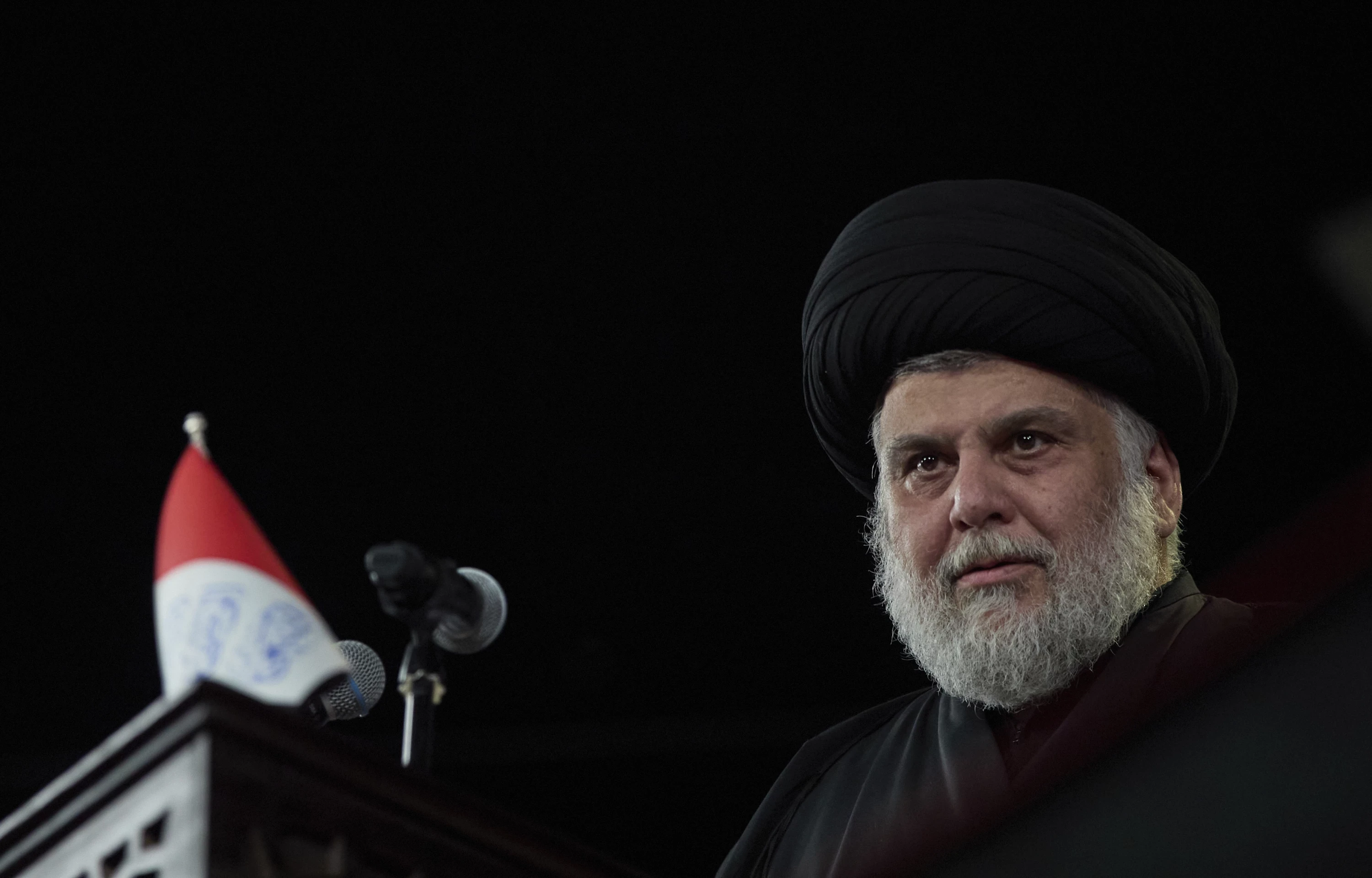
ERBIL, Kurdistan Region of Iraq – Muqtada al-Sadr, an influential Iraqi Shiite cleric, on Wednesday called on Washington to adopt a “moderate” stance toward Iraq, saying the country should not become an “arena” for US political and economic conflicts and that Baghdad is under no obligation to fight on “anyone’s behalf.”
“We refuse to let Iraq become an arena for your political and economic conflicts; we are under no obligation to defend anyone or to fight on anyone’s behalf,” Sadr said in a message to the US, a week after the US-led international coalition’s withdrawal from Iraq.
The US-led coalition against the Islamic State (ISIS) completed its withdrawal from Iraq and the Kurdistan Region last week in accordance with an agreement between Baghdad and Washington.
The cleric dubbed the withdrawal of the US troops a “positive step,” calling on Washington to “reshape” its image in the eyes of the “downtrodden” in the Middle East, “to ensure your flag is never trampled upon again,” possibly referencing a recent controversial incident where the state-linked Popular Mobilization Forces (PMF) trod on US flags in a military parade celebrating the withdrawal.
“This can only be achieved if America adopts a stance of moderation toward all, favoring neither a "spoiled child" nor any other party,” he said, with Israel widely believed to be the “spoiled child” Sadr is referring to.
“If all of this is for the sake of normalization with your "friend," then let your friend normalize relations with the entire world; for her reputation is tarnished, and the UN hall is empty of those willing to listen to your friend! It has become isolated, having turned its back on all human and international values,” he said.
Iraq maintains a hardline stance against Israel. The country’s Law of Criminalizing the Normalization with the Zionist Entity prohibits officials and media personnel from engaging with Israel in any capacity, making it punishable by death.
The Iraqi government, led by Prime Minister Ali al-Zaidi, had initially set September 30 as the deadline for armed groups to hand over their weapons, coinciding with the coalition’s withdrawal, but later shifted to a phased process extending to June 2027 after several groups rejected the deadline.
 Facebook
 LinkedIn
 Telegram
 X
X