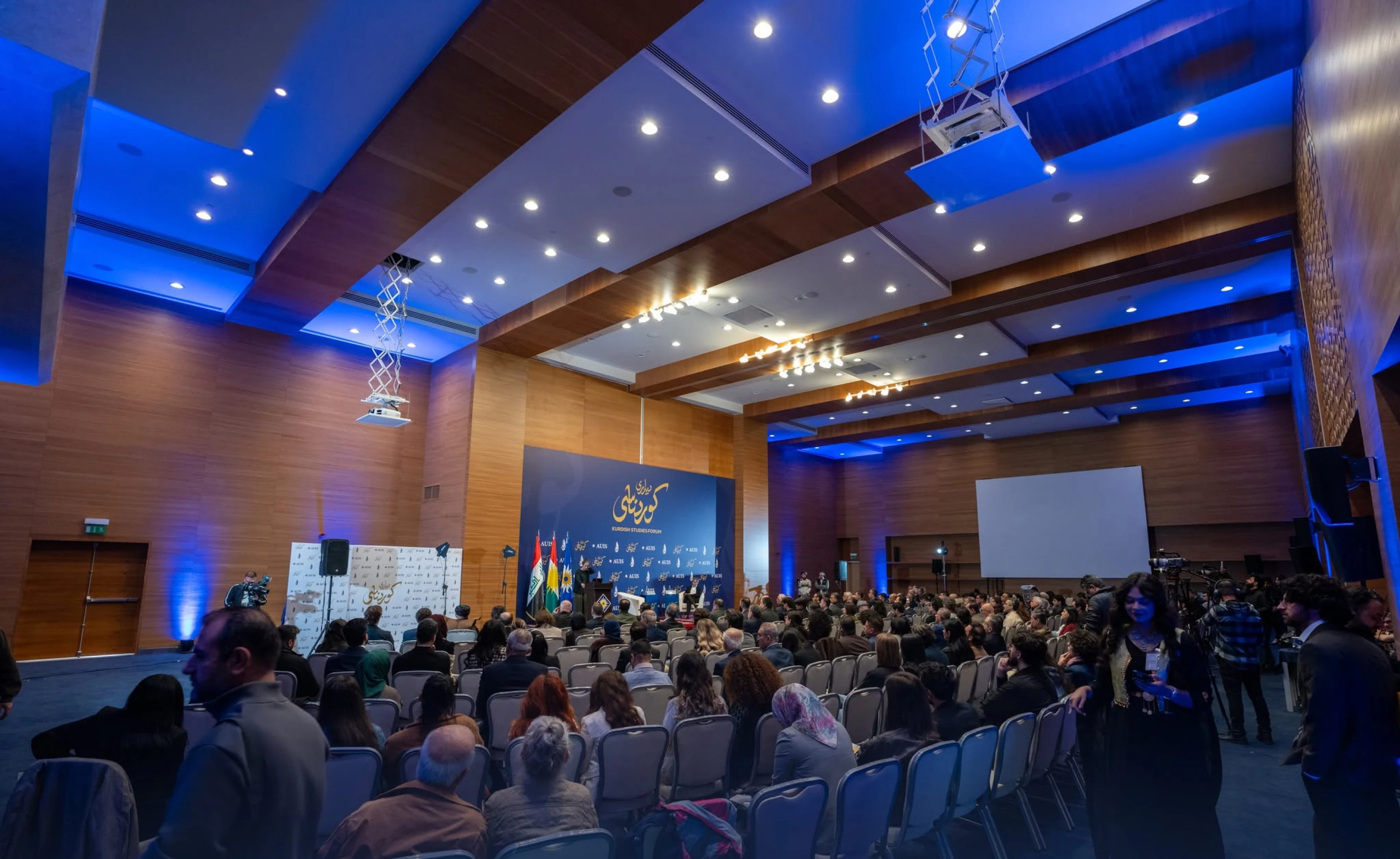
SULAIMANI, Kurdistan Region of Iraq - Scholars, writers, filmmakers and cultural practitioners have gathered in Sulaimani for the second Kurdish Studies Forum, seeking to address gaps in research on Kurdish history and culture and explore how the community can preserve its heritage through language, literature, cinema, and the arts.
The two-day forum, held on November 11–12 and organized by Kashkul, the Centre for Arts and Culture at the American University of Iraq, Sulaimani (AUIS), brings together local and international academics, cultural figures and artists. Its program includes discussions, workshops, literary readings, and artistic and musical performances.
The event takes place in a city with a long history of Kurdish intellectual and literary life. Founded in 1784 by Ibrahim Pasha Baban, Sulaimani became a centre for Kurdish writers, poets, and political thought. Its literary tradition includes figures such as Nali, Mawlawi, and Piramerd. The forum also coincides with the anniversary of the city's founding.
For Dr. Bilal A. Wahab, AUIS president, the forum is an attempt to address the limited attention Kurdish studies have received in academic institutions and to encourage Kurds to take greater responsibility for researching and documenting their own history.
“Kurdish Studies Forum was part of the vision of Barham Salih,” Wahab said, linking the initiative to Salih’s broader ambition to establish Sulaimani as a centre for intellectual debate and cultural exchange.
Salih is a Kurdish politician who served as president of Iraq from 2018 to 2022 and twice as prime minister of the Kurdistan Region. In 2006, he initiated the establishment of AUIS, which opened in 2007 as a non-profit institution offering an American-style liberal arts education. He is currently the United Nations High Commissioner for Refugees, a post he assumed in January 2026.
The Kurdish Studies Forum provides a platform for researchers and intellectuals to discuss Kurdish identity, history, literature, and heritage, said Wahab.
Giving a voice to silenced histories
Wahab said research into Kurdish history has often depended on institutions outside the region, including universities and archives in the United Kingdom and the United States. He said the forum was intended to help build a stronger academic environment in Kurdistan and encourage the preservation and translation of Kurdish cultural works.
Through Kashkul, AUIS has spent around a decade translating works by Kurdish poets and modern novelists, while also collecting and archiving cultural material, he said.
Wahab argued that culture cannot be separated from politics, particularly given the impact of repression and conflict on Kurdish identity. Events such as the 1988 chemical attack on Halabja and the Anfal campaign remain central to the collective memory of Kurds.
But he said cultural work could also create connections across political divisions, offering a way for people to engage with shared experiences and histories.
He urged Kurdish writers, researchers, and artists to document their own past, translate their literature and develop their cultural industries rather than waiting for political disputes to be resolved.
“Kurds should not wait for a political solution to preserve their history and culture,” was the message underpinning his remarks. He said greater investment in research, literature, translation, and cinema was needed to ensure Kurdish experiences were recorded and accessible to future generations.
Marc Marin Webb, an architect with a PhD in Middle Eastern Languages and Cultures, also stressed the importance of documenting histories and protecting cultural heritage, particularly in communities affected by conflict.
Webb has worked on heritage projects in Iraq, Syria, and the Kurdistan Region, including the conservation of Sheikh Abdi sanctuary in Lalish, the Yazidi religious center, since 2019.
He said the forum offered a space for histories and cultural initiatives that have often been marginalized or overlooked, bringing Kurdish and non-Kurdish perspectives into discussion.
For Webb, documenting heritage after conflict should involve more than recording destruction. Photographic archives, he said, should also capture everyday life, cultural landscapes and the experiences of communities, rather than repeatedly portraying survivors only through images of violence and suffering.
He argued that protecting, surveying, and reconstructing heritage in partnership with local communities is an ethical responsibility, particularly where conflict has damaged buildings, traditions and collective memory.
Kurdish cinema beyond conflict
On Wednesday, the challenges facing Kurdish filmmakers were also discussed during a panel on the power of minor cinema, moderated by film scholar and researcher Ozgur Cicek.
The discussion brought together Kurdish filmmakers to examine the difficulties of producing films in different parts of Kurdistan, including southeast Turkey (Bakur) and western Iran (Rojhelat), where political restrictions, limited resources, and uncertain production conditions can make filmmaking difficult.
Cicek said filmmakers often worked in conditions of persistent precarity, forcing them to improvise and find alternative ways to produce and distribute their work.
She said gaps in mainstream media coverage had also encouraged filmmakers to document experiences and communities that rarely receive sustained attention in news reporting.
However, she noted that Kurdish cinema risked becoming too narrowly associated with survival, political struggle, and violence. While those subjects remain important, she said, a wider range of stories was emerging, including documentaries about everyday life, the environment, and land-related issues.
Cicek said the diversity of approaches and perspectives among Kurdish filmmakers was important to the development of cinema, allowing different experiences to be represented rather than reducing Kurdish identity to a single narrative.
The panel highlighted how filmmakers working in different political and cultural environments face distinct constraints, while sharing a concern with documenting lives and experiences that are often absent from mainstream narratives.
Protecting Kurdish in the age of artificial intelligence
Language preservation was another central concern at the forum, particularly as artificial intelligence increasingly shapes access to information, education, and cultural production.
Wahab warned that Kurdish remains vulnerable in the digital environment, where languages with larger numbers of speakers and greater digital resources are more widely represented.
He said AI systems must be trained with authentic Kurdish-language material if they are to understand and represent the language accurately. Without sufficient investment in digital resources, Kurdish risks being further marginalized as new technologies become part of everyday communication and education.
Although English is the main language of instruction at AUIS, Wahab said the university also wants to help students engage with Kurdish literature and develop their translation skills. He said AUIS was working on an artificial intelligence program intended to help non-Kurdish speakers learn Kurdish.
For Wahab, such efforts are part of a wider responsibility to ensure Kurdish remains a living language, capable of adapting to technological change while retaining its literary and cultural foundations.
The forum's discussions, spanning historical research, heritage conservation, cinema, and artificial intelligence, reflect the different challenges involved in preserving Kurdish identity. They also point to the need for sustained academic and cultural work beyond the boundaries of political institutions.
In a region shaped by political divisions and a history of conflict, the organizers and participants see research, literature, cinema, and the arts as ways to preserve collective memory, broaden public debate and create connections across communities.
 Facebook
 LinkedIn
 Telegram
 X