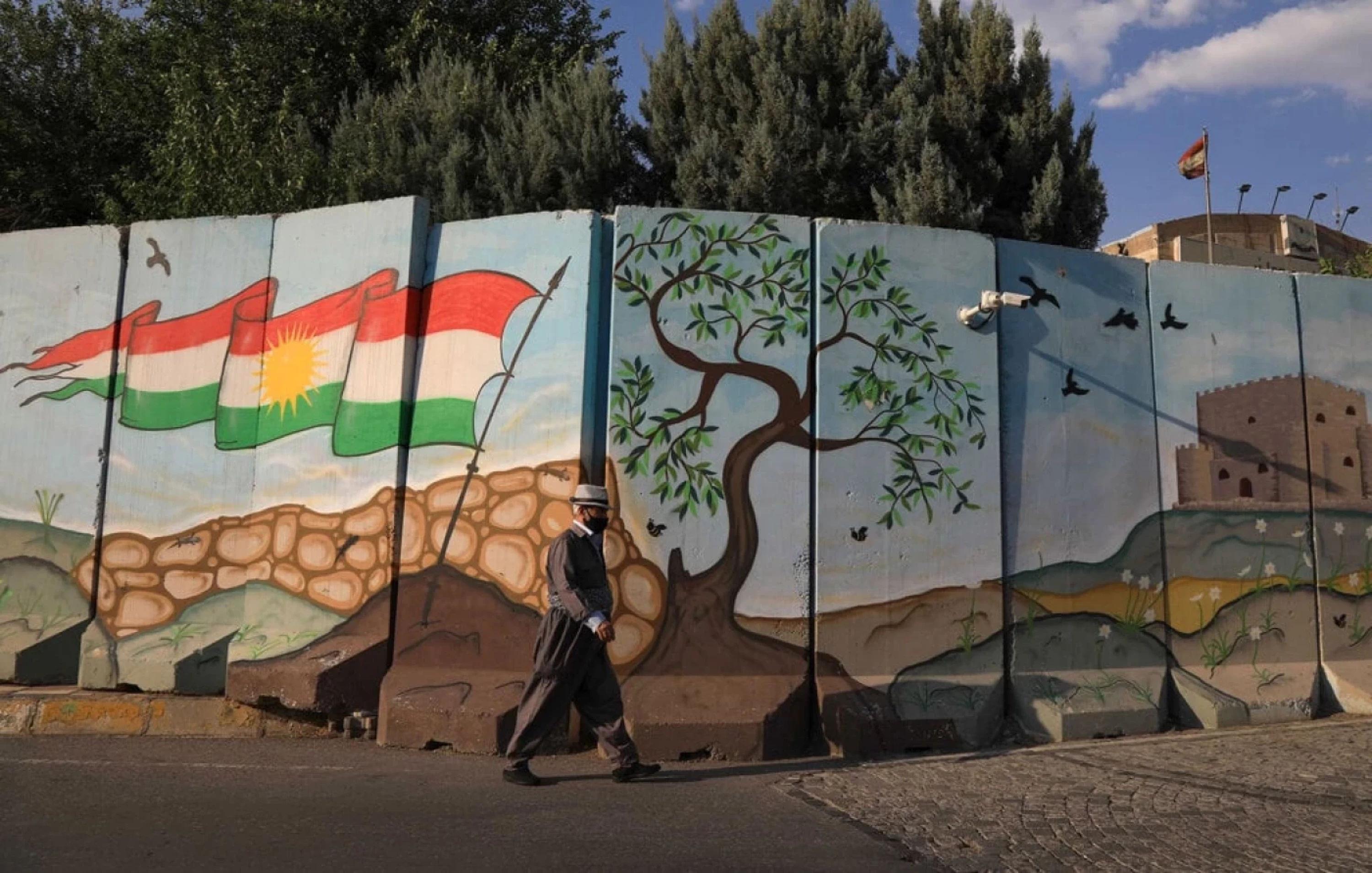
The Kurdistan Region is now gripped by a new crisis, one that appears to threaten its very survival as an autonomous region within Iraq. I say appears because, despite the hype in the media and social media, the actualization of a formal breakup of Kurdistan is not as easy as it might seem to some. And I say formal because there is also the possibility of an informal breakup that goes beyond the divisions we have seen over the past years.
The crisis was triggered when the Kurdistan Democratic Party (KDP) managed to secure a majority of 52 out of 100 parliamentarians to reconvene the Kurdistan parliament, nearly two years after its first session following the October 2024 elections. The KDP did this despite strong objections from its historic rival, the Patriotic Union of Kurdistan (PUK). Several other parties also boycotted the session, although some parliamentarians who broke away from their ranks attended.
Infuriated by the move, the PUK and its allied New Generation Movement described the parliamentary session as illegitimate and vowed to challenge it before the Iraqi Federal Supreme Court. The PUK also recalled its ministers from the current cabinet, while its leader, Bafel Talabani, threatened to establish a separate administration in Sulaimani and Halabja provinces, which his party controls. These are serious threats coming from the very helm of the party.
There are three important questions to address here: Why did things get to this point? Can the PUK actually establish a separate administration in the areas under its control? And finally, what is the path forward?
How did things get here?
The frank answer to the first question is the PUK's deliberate obstruction of government formation following the October 2024 Kurdistan elections. This is a serious accusation, but one that can be supported with evidence.
To understand why two years of negotiations have failed to produce a government, one must ask a critical question often overlooked: Who benefits from the ongoing delay? The answer is the PUK.
The PUK has already secured Iraq's presidency in Baghdad, one of the country's three highest offices, conventionally reserved for the Kurds since 2005 under Iraq's informal intercommunal power-sharing arrangement. The position is not really the PUK's entitlement under the prevailing methods of allocating high offices. Among Sunnis, the parliamentary speakership generally goes to the largest party, while Shiite factions negotiate the premiership among themselves. The PUK is not the largest Kurdish party in Iraq; the KDP is. And the PUK did not seek negotiations with other Kurdish parties over the position.
The PUK also secured Kirkuk's governorship in 2024, bypassing the KDP, which could have joined Sunni and Turkmen groups earlier to be part of a governing coalition but chose not to. Meanwhile, the PUK already governs roughly half of Kurdistan, whether a new KRG cabinet is formed or not. These are major gains for a party that is a second-tier force in Kurdistan and a third-tier one in Iraq, leaving it with little, if any, incentive to help form a new KRG cabinet, which the PUK sees as a boost to the KDP’s position in Kurdistan and Iraq.
The dual tracks of Iraqi and Kurdish politics have made this possible. Shiite factions and Tehran's animosity toward the KDP, particularly following the unsuccessful 2017 Kurdish independence referendum and the KDP's alliance with Muqtada al-Sadr after the 2021 Iraqi elections, has encouraged them to empower the PUK beyond its electoral weight.
The objective is to weaken the KDP and ultimately Kurdistan's autonomy, which the Shiite groups view as the most significant obstacle to their efforts to assert authority over Iraq’s entire territory.
With each passing day, the delay in forming a new KRG has reflected negatively on the KDP and the legitimacy of the regional government, of which it is the senior partner. Having been considerably sidelined in Baghdad relative to its electoral size and pushed out of the political game in Kirkuk, the KDP has been losing the most from the ongoing stalemate. This helps explain why the PUK has been deliberately stalling the formation of the new KRG.
Can Kurdistan be divided?
The second question is whether the PUK can separate Sulaimani and Halabja from Kurdistan to establish a new autonomous region. This would be an extremely challenging undertaking.
First, neither the Iraqi Constitution nor the 2008 law governing the establishment of new regions explicitly provides for breaking away from an existing autonomous region to establish another. Under the Iraqi Constitution and laws, regions enjoy far greater autonomy in governing their internal affairs than provinces.
Secondly, Baghdad's recognition of a separate PUK-dominated region could encourage provinces such as Basra, Anbar, Nineveh, and Salahaddin to pursue similar arrangements. This is something Iraq's Shiite political class has opposed over the years, viewing it as a loss of their control over these provinces and a possible prelude to the country's eventual partition.
There would also likely be substantial opposition from other Kurdish parties and large segments of the population in PUK-controlled areas. Many Kurds across the Middle East and beyond would view such a move as a betrayal of the Kurdish national cause.
Yet despite the unlikelihood of formal recognition, Baghdad could accept, or even encourage, the functioning of Sulaimani and Halabja as a de facto separate administration.
This would allow Baghdad to avoid the difficult consequences of legally recognizing a new region while using the arrangement to undermine the KDP and Kurdistan's autonomy. It could involve sending salaries and budget allocations directly to Sulaimani through the new budget law currently being negotiated, through legal loopholes, or as a fait accompli.
But Baghdad would hardly agree to such arrangements without seeking greater control over local trade routes, taxes, and customs collection, possibly even deploying Iraqi troops and Iran-backed Popular Mobilization Forces to Sulaimani and Halabja provinces.
Such a scenario would effectively relegate the new administration to the status of an ordinary Iraqi province like Kirkuk, rather than an autonomous region. Would the PUK accept that? Doubtful, since it would enjoy far fewer powers than under the current KRG arrangements.
There is also a political dimension. A separate Sulaimani-Halabja administration would not guarantee the PUK the advantageous position it currently enjoys in Baghdad. Its value to Shiite factions and Iran as a counterweight to the KDP would likely diminish.
Nor could the PUK continue blaming the KDP for governance problems in its territory. With roughly a quarter of the votes in Sulaimani and Halabja, the PUK would face considerable challenges from other parties within its own zone of control.
The way forward
This realization may explain why the PUK leadership has not closed the door on negotiations. Despite withdrawing its ministers and employing tough rhetoric, there remains considerable room for pragmatism.
The KDP has likewise left the door open. Its reconvening of parliament appears to have been a calculated measure, not intended to exclude the PUK, but to jolt it into taking government formation negotiations more seriously.
Although the KDP could technically form a government without the PUK, it does not appear willing to pursue that path.
The decision to reactivate parliament also appears partly driven by the prospect of an unfavorable Federal Supreme Court ruling in December that could invalidate the current parliament and caretaker cabinet. Such an outcome would primarily undermine the KDP, for the reasons discussed earlier.
Both parties should therefore seize this moment to negotiate a comprehensive new power-sharing agreement. Following a series of PUK maneuvers over the past couple of years that came at the KDP’s expense, the KDP has now demonstrated that it, too, can outmaneuver the PUK. This moment should be seized as an opportunity to reset relations and move toward a win-win approach rather than continuing to treat their rivalry as a zero-sum game.
A new deal would require the KDP to share a larger portion of power than the PUK's electoral weight would ordinarily justify, essentially reviving the spirit of their 2006 strategic agreement between the two parties.
This might seem unfair to the KDP at first glance. But in the long run, it would serve the KDP as well by ensuring stability, predictability, and order within Kurdistan, while strengthening Kurdish representation in Baghdad to defend Kurdish rights and constitutional entitlements.
For its part, the PUK must stop aligning itself with pro-Iran Shiite factions whose broader objective is to weaken Kurdistan's autonomy, even if they temporarily empower the PUK to achieve that goal.
It must also strengthen its popular standing in Sulaimani and Halabja rather than allowing smaller parties to continually challenge its authority and spoil any deal with the KDP.
Those who have followed Kurdistan closely over the past two decades know that internal fragmentation within the PUK and its zone of control has been the major source of Kurdistan's recurring crises since 2009.
This dynamic transformed a once-committed power-sharing partner into a source of recurring crises, increasingly seeking to compensate for its declining electoral weight through hostility toward the KDP and alliances with anti-KDP and anti-Kurdistan forces in Baghdad.
If negotiations fail, the PUK should consider becoming a formal parliamentary opposition inside the Kurdistan Region. It would still exercise de facto control over its territory while using opposition politics to strengthen its position and potentially regain votes lost to smaller parties in Sulaimani over the past decade and a half.
Ultimately, Kurdistan's two dominant parties must recognize that their shared interest in preserving the region's autonomy outweighs the temporary political gains either can secure at the other's expense.
The views expressed in this article are those of the writer and do not necessarily represent the position of The New Region's editorial team.
 Facebook
 LinkedIn
 Telegram
 X