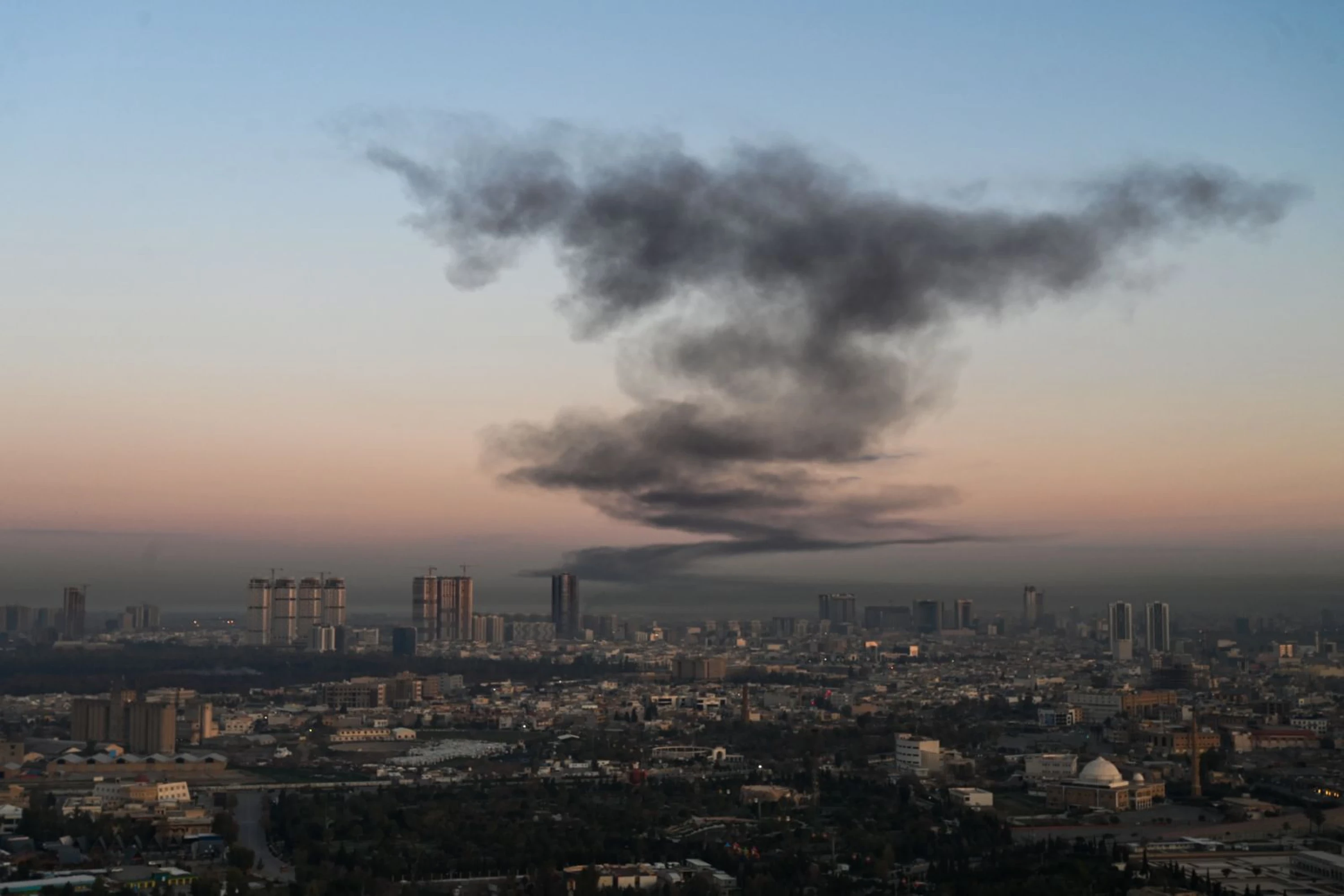
Early in the morning, on the 34th day of the US-Israeli war on Iran, I woke up to a large column of black smoke billowing in the outskirts of our village west of Erbil. In my sleepy-eyed state, I had no idea what was burning or what might be the cause, but moments later, taking one of my dogs for a walk I saw a neighbor, a young student of microbiology, sitting on a hill, reading a school book, and tending to his father’s flock of sheep, and he told me that the smoke was from a fire caused by a drone strike on a plastic factory on the road to Mosul.
The smoke kept rising, getting thicker by the minute, blowing with the winds onto the skies of Erbil city and visible from many miles away. A couple hours later and through local news media, I learned that it was a motor oil facility that had been attacked by four drones. It made sense now. The type of smoke was definitely from some sort of oil product. Fortunately, no one had been harmed as the incident had happened very early in the morning and before the staff had shown up for work.
Standing on a hilltop and comparing what I was seeing with my own eyes to videos that began flooding social media pages, there was the constant sound of fighter jets overhead and close by. I looked up and tried hard to see them, but their speed, distance and sporadic patches of spring clouds made it impossible. But then, just as I gave up on trying to locate the menacing sound, a fighter jet appeared out of nowhere and descended to the lowest point I have ever seen a fighter jet. It intercepted a drone before my own eyes, above some wheat fields not more than a mile away. The drone was blown to pieces and the sound of the explosion with the jet’s own deafening boom filled the entire area. Within a couple hours, many videos of the jet, captured by local bystanders, surfaced on the internet and I learned that it was an F-15 that had downed the drone and missed a few others. Standing on the deck of USS George H.W Bush in Bahrain in 2017, I had seen jets taking off on bombing missions against ISIS in Iraq and Syria, but I had never seen them in action this close.
It certainly was not the first drone to be intercepted in the skies over our village during this latest war. I counted at least a dozen flying by, sometimes so low that if I were a drone expert I would have been able to tell their details and make. In most cases they were intercepted around us, or after passing our village and before reaching the Erbil airport or whatever their intended target.
Most of the drones came from the direction of Mosul, which lies west of us and they were most probably launched from areas under Iraqi militia groups known as the Popular Mobilization Forces (PMF, or Hashd al-Shaabi) in the Nineveh plains.
The war completely transformed our village sky. A normal morning in my village, before the war, would involve observing one new bird or another that would come to the farms, creeks and fields of our area. Most mornings it would be a small flock of wild ducks or a couple of hawks hovering around. Now, with spring in full bloom, it is the season of swallows. They come in family groups, fly over our ponds catching mosquitoes and insects, and land so gently on reeds that they wouldn’t cause the slightest move in the reed-bed. During rainstorms, they take shelter on lamp frames under the ledge of my house. Hoopoes, larks and kestrels are among them, not to mention various owls that visit us after dark.
This harmonious chorus of birds was mixed with the sound of drones, rockets, fighter jets, bombers, transport planes, and helicopters. On a few occasions, I managed to film the action, and whenever I checked the videos later on, I would see birds and drones on the screen, flying in different directions. The explosions rattled the entire village and I noticed every creature shaken out of their peaceful routine. For instance, the moment a drone fell not far behind my house, a huge flock of rock pigeons that had been feeding invisibly on rocky hillsides, dispersed and disoriented. During nighttime interceptions, I couldn’t see the birds, but I would hear them, especially lapwings and stilts, screech and take off into the darkness. My own and other village dogs also began making a distinct sound that I only began to hear with the start of the war and it was certainly the sound of fear.
As a journalist covering various wars and conflicts in Iraq, I have seen fighter jets and bombers in action. During the US invasion of Iraq in 2003 to topple Saddam Hussein’s regime, I would stand next to American spotters on the frontlines and see them call in air strikes against enemy positions. I would hear the distant sound of the jets before closing in and dropping devastating bombs on their target, which all looked like a movie or a video game played by someone else.
This war, however, was literally much closer to home. So close that I a few times thought the drones may actually come through my window or at least fall on my rooftop if intercepted there. Those close-call drones often fell nearby and I felt the shake, saw the smoke and heard the bang. These occasions took me back to my childhood of the 1980s and the days of the Iran-Iraq war. It brought back precautions we had been taught as children to take for our safety during a bombardment. So every time one of those drones came by, I would instinctively lie flat on the floor to avoid flying shrapnel and debris, keep my mouth open, and avoid blocking my ears.
History here does really repeat itself.
One day in the very early days of the war, I counted more than thirteen jets, very high in the sky and shining white in the sunlight, flying eastward towards Iran, and later that day came the news of heavy bombing rounds in Iran. Just like how the fighter jets, bombers and drones replaced the myriad of birds in the sky, these military jets also replaced the countless number of transcontinental commercial planes I used to sit and watch from my front lawn before the war and wondering which country they were flying to.
 Facebook
 LinkedIn
 Telegram
 X
X