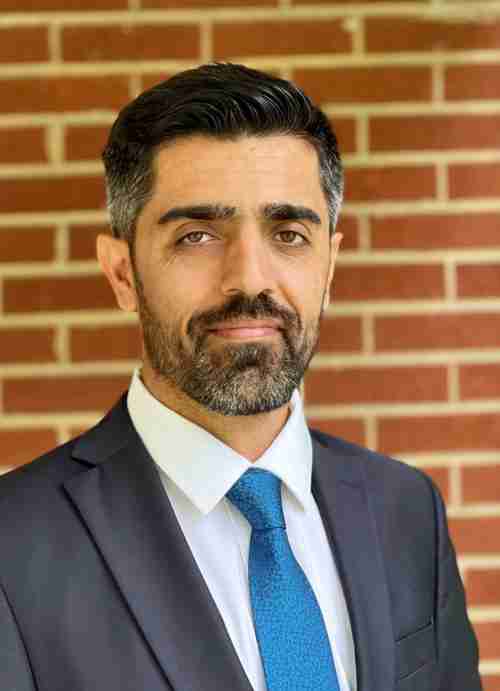
In the latest episode of The New Region's GeoSpace podcast, host Mohammed A. Salih sits down with Dr. Amy Austin Holmes, research professor of international affairs at the Bush School of Government and Public Service, speaking from inside Syria, to discuss the country's fragile political transition, the convening of its new parliament, and the unresolved questions facing Kurdish and other minority communities under the new authorities in Damascus.
Holmes, who has traveled extensively across Syria since the fall of the Assad regime and is currently on her fourth visit to the country, described a mixed picture on the ground. "Some people seem to be more optimistic about the current situation than I expected, but other people are more pessimistic than I expected," she said.
On the positive side, she pointed to the return of displaced communities as a sign of progress. All 700 Yazidi families who had been displaced from Afrin following the 2018 Turkish intervention have been able to return to their homes, she said, describing it as "very exciting news."
The convening of Syria's new 210-member parliament on July 12 was also welcomed as a historical milestone, though Holmes noted deep reservations about how it came to be. Two-thirds of its members were indirectly chosen by interim President Ahmed al-Sharaa, and one-third were chosen by him directly. "There are concerns about a lack of real democracy in terms of how this parliament came about," she said.
On the Kurdish question, Holmes highlighted the disconnect between the scale of Syria's Kurdish population and their representation in the new parliament, where only 12 of 210 members are of Kurdish background. Many Kurds she spoke to expressed concern that this did not reflect their demographic weight or political aspirations.
The ongoing integration of the Kurdish-led Syrian Democratic Forces (SDF) into the national army remains a central and unresolved issue, she said. While a March 10 agreement between SDF commander Mazloum Abdi and Sharaa set out a framework, implementation has been slow and trust remains limited. "People feel that the SDF, which has protected them, may be dissolved before there are guarantees in place," she said.
Holmes was particularly pointed on the situation in areas under Turkish-backed Syrian National Army (SNA) control, where she said Kurdish and Yazidi communities continue to face displacement and insecurity. "What I'm seeing there is a situation that I would describe as ethnic cleansing," she said, adding that these communities are being pushed out and their properties taken.
On language rights, she noted that Kurds and Assyrians are pressing for their indigenous languages to be recognized and taught in schools, not treated like foreign languages. "The Syrian government has suggested that Kurdish can be taught like English or French," she said, "but the Kurds make the point that this is not a foreign language. It's a language indigenous to Syria."
On the constitution, Holmes was cautious. "I would like to think that the parliament can play a meaningful role," she said, "but what happens with the constitution drafting process will be something that will have to be monitored." She noted that some communities place more faith in maintaining their own security forces than in legal guarantees. "I've heard people say that really maintaining SDF security forces in control of this area is what is going to protect them more than the constitution."
 Facebook
 LinkedIn
 Telegram
 X
X