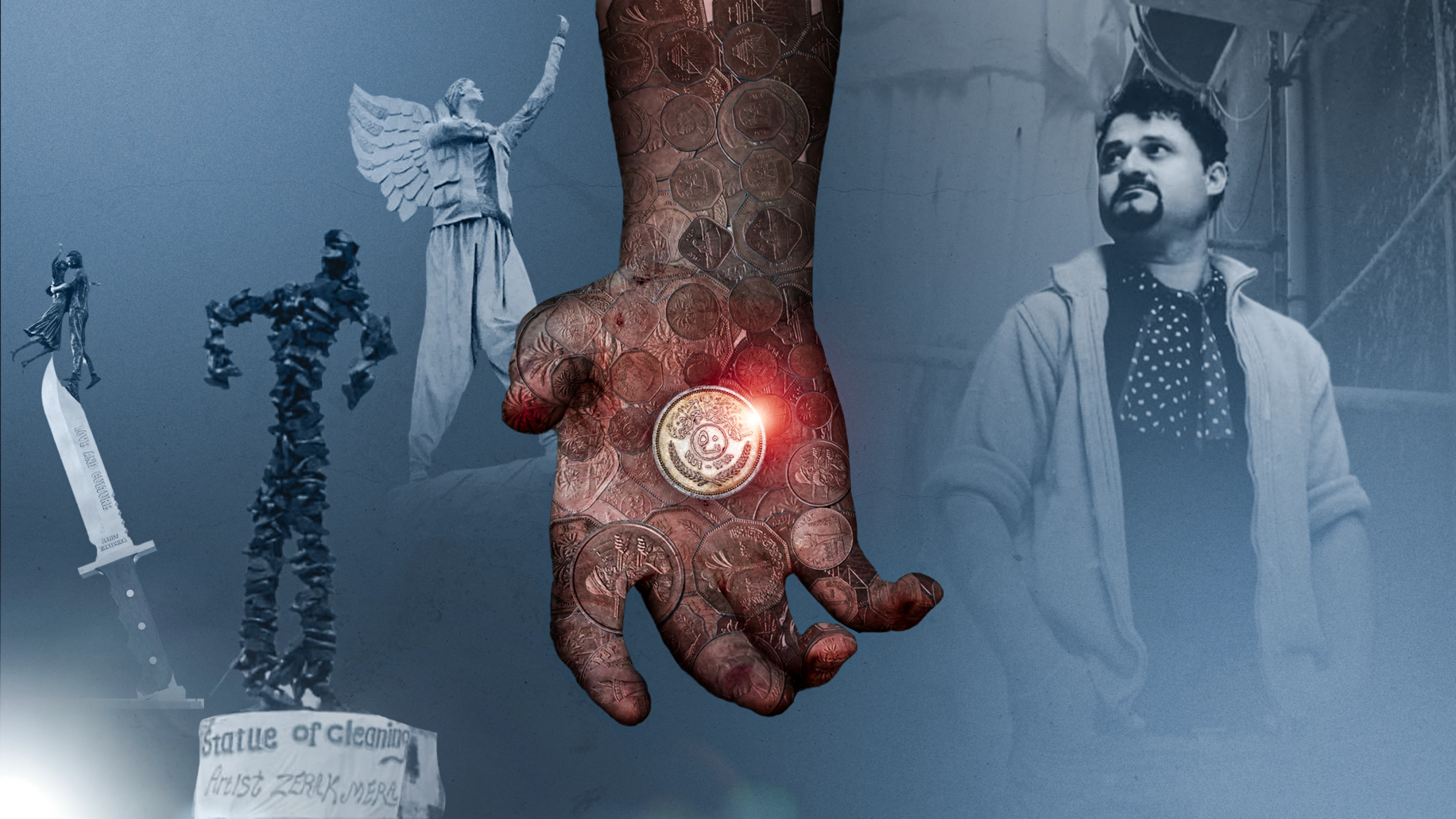
MILAN, Italy – The economic collapse of the Iraqi state in the 1990s left a large segment of the population of one of the world's richest countries in natural resources dependent on the kindness of strangers. Decades after the fall of the Baath regime, Kurdish artist Zirak Mira now hopes to bring to life one of his earliest ideas: a statue of a beggar forged from old Iraqi coins.
In the 1970s, Iraq's economy was considered one of the strongest in the Middle East, driven by the oil boom and the nationalization of the oil industry. Its human development indicators and education system were also among the region's most highly regarded. Yet the international sanctions imposed on Iraq in the wake of its 1990 invasion of Kuwait obliterated many of the gains made in previous decades, resulting in soaring poverty rates and child mortality.
Mira, a prominent sculptor from the Kurdistan Region of Iraq known for his surreal works that often carry political commentary, aims to immortalize the hardships endured by millions of Iraqis, including his own family, during the height of the economic collapse.
An eight-meter-tall statue of a beggar, hunched over with an outstretched palm and made entirely from discontinued Iraqi coins, is a vision Mira conceived in his early 20s and has sought to realize ever since. The idea came to him while he was in Baghdad finalizing another project.
“This is a multidimensional statue, containing philosophical, social, and political dimensions,” Mira told The New Region on Sunday. “Under the Baath regime, the Iraqi state possessed immense wealth, yet the actions of its rulers left ordinary people scouring the streets in search of their daily bread.”
“The wealth that was meant to bring dignity and prosperity to Iraq’s people became a tool of destruction. The resources of the country were transformed into weapons that were ultimately turned against its own citizens, especially the Kurds,” Mira added.
Commentary on Baath-era Iraq has shaped much of Mira's work over the years. In 2003, Mira sculpted the Purification Statue, a large boot-shaped sculpture made from discarded footwear and abandoned military equipment of Baathist soldiers, which was installed in the city of Kirkuk in place of an imposing statue of Iraq’s toppled dictator Saddam Hussein.
In that same year, he also built the Sun of Liberty Statue from the remains of Baathist military equipment. The sculpture was unveiled in Baghdad’s Firdos Square – once home to the large Saddam effigy which was destroyed by Iraqi civilians and US marines following the 2003 American invasion.
“I drafted a proposal and submitted it to the Iraqi Governing Council and the Americans. I was then informed that the British were the ones in charge of Iraq’s coinage and banking, and I went and met with them in Basra. But regardless, I was unfortunately unable to acquire the coins then.”
“I believe that there is now a large number of those Iraqi coins being traded in the black market, and I think I can obtain enough of them to forge the statue,” Mira asserted.
The artist said the sculpture would break the Guinness World Record for the most metal coins used in a single statue, making it a unique tourist attraction for the Kurdistan Region while also commemorating one of the darkest chapters in Iraq's modern history.
Mira has cultivated an unmistakably distinctive style. His works are often instantly recognizable owing to their mounmental proportions and the elements used to sculpt them.
“I do not have a fixed set of materials that I use for my work. I always employ the tools that the product requires. The piece begets the material,” he stated.
In 2016, Mira sculpted the Berxwdan (Resistance) Monument – a statue honoring Kurdish female fighters in northern Syria’s Kobani. The art piece has become a symbol of the Kurdish town’s resistance, and has been adopted as the official icon of many local institutions in Rojava, including the University of Kobani, as well as the Kobani International Film Festival which takes place annually in Germany.
Iraqi dinar coins were first issued in 1931 during the monarchy, with the dinar officially replacing the Indian rupee as Iraq’s national currency a year later. Production continued after the establishment of the Republic of Iraq before ceasing in 1990 following the Gulf War. In 2004, a short-lived series of coins was introduced, but it was soon withdrawn from circulation, leaving Iraq to rely exclusively on banknotes.
 Facebook
 LinkedIn
 Telegram
 X
X