
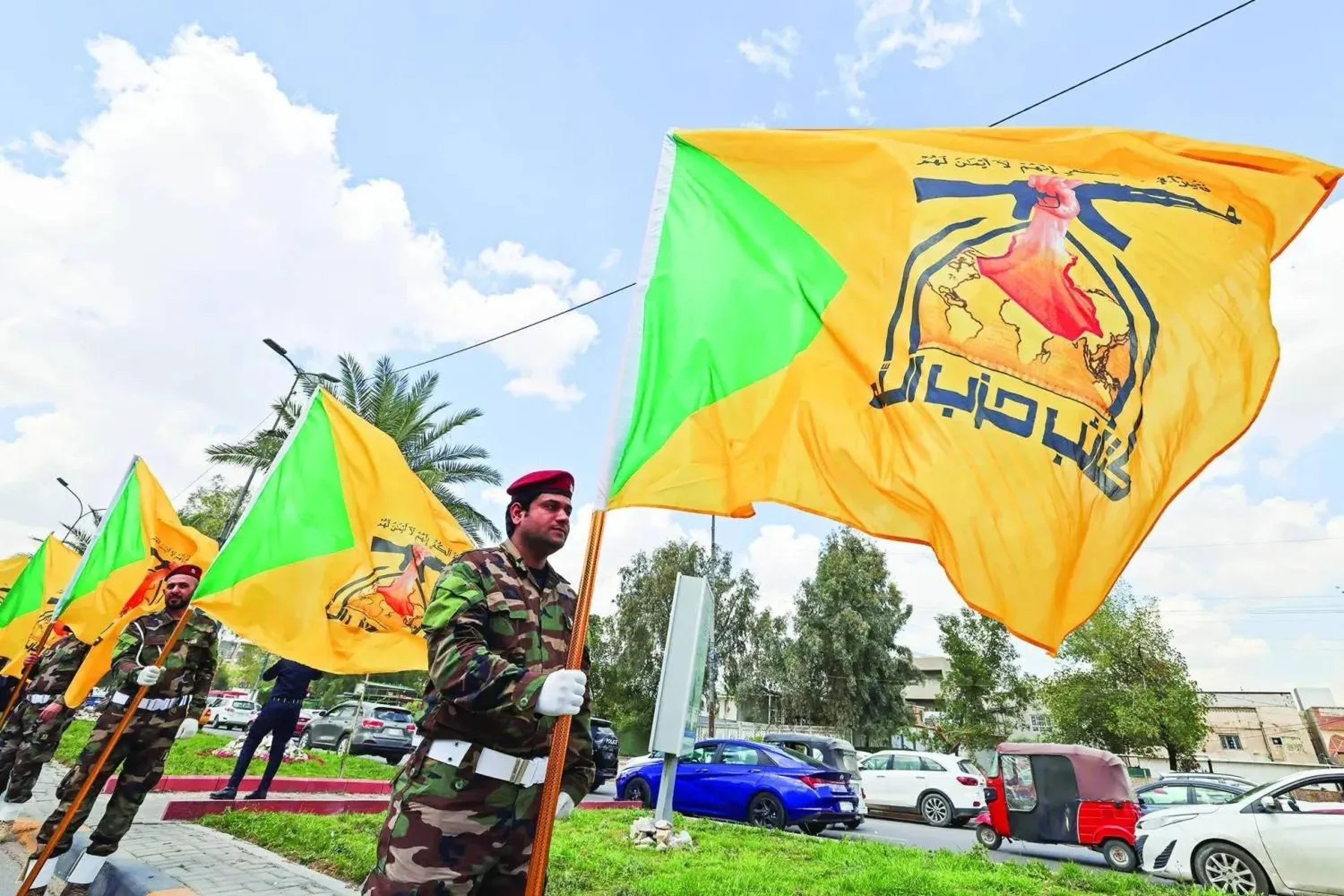
BAGHDAD, Iraq – Government contracts worth billions of Iraqi dinars that were recently terminated by Prime Minister Ali al-Zaidi have been traced to companies linked to a wider business network controlled by US-designated Kataib Hezbollah leader Abu Hussein al-Hamidawi and his associates, according to government records and Iraqi security officials who spoke to The New Region.
Government records reviewed by The New Region show that Kataib Hezbollah (KH) has built an extensive network of companies and business partnerships over the past decade, operating across sectors including tourism, transportation, aviation services, security, food supply, armaments, agriculture, and construction.
Iraqi officials involved in the investigations said the network has helped the faction secure lucrative government contracts worth billions of dinars.
The findings come as Zaidi intensifies a campaign to choke off the financial resources of KH and other Iran-backed armed factions, targeting oil-smuggling networks linked to the group and government contracts suspected of generating revenue for armed factions operating outside the law.
The campaign marks one of the most significant confrontations between the Iraqi government and powerful Shiite armed factions since 2008, when then-Prime Minister Nouri al-Maliki launched a military offensive against Muqtada al-Sadr’s Mahdi Army in Basra.
Unlike that confrontation, however, Zaidi is targeting the factions’ financial resources rather than their armed formations.
The measures are part of Zaidi’s efforts to curb corruption and reclaim control over state resources long exploited by political parties and armed factions.
If successful, they could undermine KH’s decade-old commercial empire while signalling the government’s determination to challenge the factions’ economic influence and bring all weapons under state control.
“Investigations have revealed that the key sources of funding for KH come from securing government contracts through either intimidation or inducements, and from smuggling stolen oil,” a senior Iraqi security official familiar with the investigations told The New Region.
“KH challenges the government daily, undermining state security and judicial institutions while simultaneously feeding off their resources,” the official said, stressing, “This situation must come to an end.”
“Without cutting off their economic lifeline, the government’s efforts to combat corruption or bring all weapons under state control cannot succeed.”
The Hamidawi family’s business network
An analysis of official corporate registration records by The New Region identified at least ten companies established between 2014 and 2025 under the names of Hamidawi’s brothers, sons, and nephews.
The network began taking shape in 2014, when four limited liability companies (LLCs) were registered within five months under the name of Awqad Mohsen Faraj, Hamidawi’s younger brother. Three of them specialised in travel and tourism, Hajj pilgrimage services, and passenger transportation.
Their concentration in travel-related business gave the group access to a sector long used to obtain US dollars at official exchange rates for resale or smuggling.
Armed factions, political groups, and currency brokers have long exploited travellers’ dollar allocations by arranging nominal trips, collecting their US dollar entitlements, and diverting the funds to the parallel market or smuggling them into neighbouring countries, officials said.
Awqad was designated by the US Treasury in January 2024 for allegedly raising funds for KH through businesses he managed, facilitating the group’s money-laundering operations, and participating in cross-border smuggling activities.
The family’s business interests soon expanded beyond travel and tourism into sectors offering access to larger commercial opportunities and government contracts.
In August 2016, Hussein Ahmed Mohsen, one of Hamidawi’s sons, registered a food trading and supply company with a capital of one billion Iraqi dinars.
That same month, an aviation company was established with capital of 1.5 billion dinars, with Awqad holding half of its shares, records show.
In June 2017, Awqad and Nour al-Din Ahmed Mohsen, another of Hamidawi’s sons, jointly established a company specialising in general trade, contracting, real estate, and tourism investment, with registered capital of one billion dinars.
Nour al-Din subsequently established a separate real estate investment company in March 2019.
The family’s business interests diversified further in early 2025, when three of Hamidawi’s nephews became shareholders in two companies operating in agricultural investment, livestock, import and export, and the recruitment of Iraqi and foreign workers.
While the family continued to diversify its businesses, its earlier expansion into aviation and contracting had secured some of the network’s most lucrative government deals.
Iraqi officials familiar with the investigations told The New Region that KH exploited its influence within Iraq’s aviation authorities to secure dozens of contracts worth billions of dinars at Baghdad International Airport under successive governments, particularly those of former prime ministers Adel Abdul Mahdi and Mohammed Shia’ al-Sudani.
The contracts covered aircraft logistics, transportation of official delegations, VIP security, catering, private jet charters, management of VIP lounges, cleaning, baggage screening, and air cargo services, the officials said.
Beyond the substantial revenue they generated, the contracts gave KH access to some of the airport’s most sensitive security facilities. Iraqi officials said the faction took advantage of that access for surveillance and the smuggling of dollars, weapons and fighters, making the airport contracts particularly valuable to its financial and operational networks.
A decision issued by Zaidi in late May to review major contracts previously awarded by government ministries and institutions is beginning to yield results. The audits aimed to determine whether the contracts complied with Iraqi laws and regulations and identify individuals or entities that had profited from them at the expense of the public interest.
On November 4, Iraq’s Federal Commission of Integrity said a review of contracts involving the Ministry of Transport and the Civil Aviation Authority had uncovered financial and technical manipulation benefiting armed groups operating outside the law.
The investigations have led to the termination of several government contracts, decisions not to renew others and the referral of individuals implicated in suspected irregularities to the judiciary, officials said.
Among the largest projects terminated was a nearly $22.5 billion deal signed in January 2024 to rehabilitate the railway connecting the Faw port in southern Iraq to Fishkhabour near the Turkish border. The contract was awarded to a consortium of three companies linked to fugitive Iraqi businessman Noor Zuhair, who was convicted in Iraq’s multibillion-dollar tax deposit theft scandal, codenamed the “Heist of the Century.”
Although Zuhair has been linked to other Iran-backed armed factions, corporate records reviewed by The New Region did not establish a direct connection between KH and the consortium.
The government also terminated a $764 million contract signed in October 2025 to rehabilitate and operate Baghdad International Airport. The contract was awarded to a consortium comprising Amwaj International Real Estate Investment Holding, owned by Iraqi businessman Namir Karim al-Eqabi, and Corporación América Airports, a leading international airport operator.
Corporate records did not establish a direct connection between KH and the consortium, although Eqabi is known for his ties to former prime minister Sudani.
Three other contracts involving the Ministry of Transport and the Civil Aviation Authority for services at Mosul International Airport were also terminated. The contracts involved two Iraqi companies and one Emirati firm.
Although records did not establish direct links to KH, officials familiar with the investigations said two of the companies were linked to Asaib Ahl al-Haq, another powerful Iran-backed armed faction.
Not all contract terminations have been publicly disclosed, however. KH has emerged as a central target of the crackdown, with scrutiny extending to companies, business associates, and individuals linked to its commander, Iraqi officials told The New Region.
“Abu Hussein [al-Hamidawi] regarded the investigations into his current and previous contracts as an insult and a direct challenge to his authority,” a senior PMF official told The New Region.
“The confrontation has since become personal. It escalated sharply after Zaidi threatened to arrest Hamidawi’s sons over alleged irregularities involving government contracts.”
The hidden partners
Beyond its family-controlled commercial network, KH has profited from lucrative government contracts through undisclosed partnerships with major Iraqi private companies, Iraqi officials familiar with the investigations told The New Region.
The arrangements allowed KH to use its political influence to help companies secure contracts worth billions of Iraqi dinars, while receiving a share of the proceeds through business associates and deals involving corrupt government officials, without appearing as a formal shareholder or partner, officials said.
A substantial share of these revenues came from contracts awarded through Iraq’s Defense Industries Commission (DIC). Committees reviewing the commission’s previous contracts found that agreements to supply weapons, military equipment, and security-related materials to government ministries and institutions had been channelled through a select group of intermediary Iraqi companies, bypassing procurement regulations and competitive bidding procedures, officials familiar with the investigations told The New Region.
Investigators also found that prices were grossly inflated relative to the equipment’s specifications and countries of origin, while delivery schedules, supply conditions, and warranty provisions favoured suppliers at the expense of government institutions, the officials said.
“Imagine a drone that costs no more than $5,000 on the market being sold to the Iraqi government for $80,000,” one official explained.
“The prices are absurdly inflated because every contract involves four parties: the original manufacturer, the intermediary company, a hidden partner and a corrupt official.”
Zaidi has ordered the termination of contracts with intermediary companies and directed government institutions to purchase weapons and military equipment directly from manufacturers, aiming to cut costs and curb corruption.
Contracts awarded through DIC have generated substantial revenues for some political factions and Iran-backed armed groups in recent years, officials said.
Neither Zaidi nor the Federal Commission of Integrity has publicly identified the beneficiaries of the inflated contracts, but officials familiar with the investigations said KH was among the principal beneficiaries.
A KH spokesman denied on November 5 that the faction had any relationship, partnership, or intermediary role involving the commission.
However, Iraqi officials, including two senior PMF officials, told The New Region that at least five arrest warrants had been issued roughly two weeks earlier for PMF commanders linked to KH in connection with the investigation.
Salah Mahdi al-Maksousi, the PMF official responsible for technical equipment, was among those named in the warrants, the officials said. Intervention by other senior PMF leaders seeking to contain the dispute between Zaidi and Hamidawi led to the temporary suspension.
Maksousi has been under US sanctions since 2012 over his alleged involvement in KH attacks against US and coalition forces in Iraq.
The confrontation has intensified further in recent days after Zaidi reportedly gave KH until Friday to withdraw from Jurf al-Nasr, south of Baghdad, long controlled by the faction, and hand over its positions to the Iraqi army.
The ultimatum followed findings implicating the faction in years of organised oil theft and smuggling.
“Unfortunately, all indications suggest that we are rapidly heading towards a confrontation between Zaidi and KH,” a senior PMF official told The New Region.
“Zaidi has tightened the screws considerably on Hamidawi and his associates. He has cancelled their contracts with the Defense Industries Commission and at Baghdad airport, and is threatening to arrest their commanders and family members.
“Hamidawi is stubborn and reckless. He will not back down easily. We hope other leaders will succeed in restraining both sides and defusing the crisis.”
 Facebook
 LinkedIn
 Telegram
 X