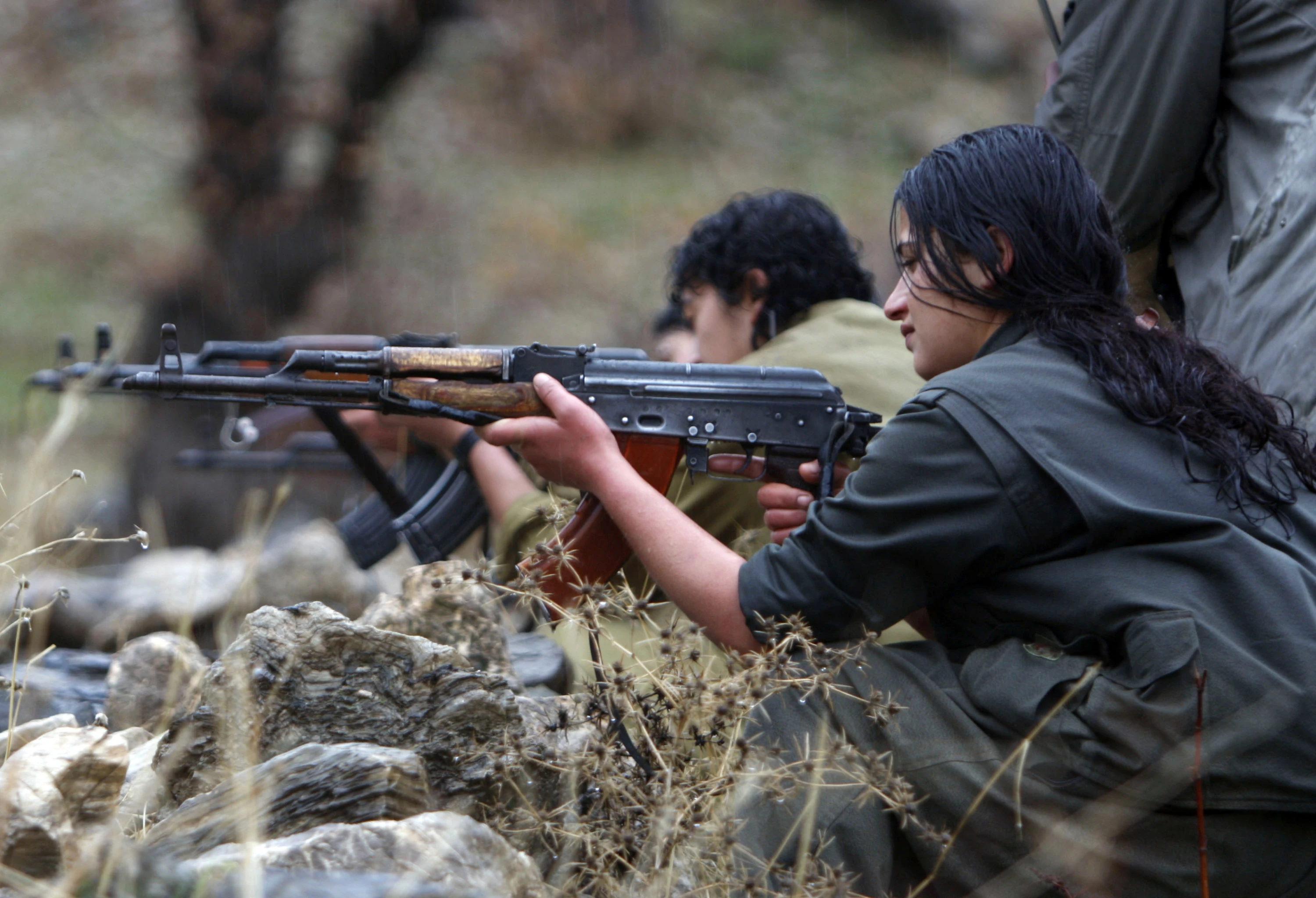
BAGHDAD, Iraq – Iran is leveling greater pressure on Iraq to relocate members of the Kurdistan Free Life Party (PJAK), an Iranian Kurdish opposition group, and hand over dozens of its “most wanted” members, sources familiar with the matter told The New Region, amid an uptick in PJAK’s clashes with the Islamic Revolutionary Guard Corps (IRGC).
Iran has demanded that Iraq removes PJAK, an Iranian Kurdish opposition group affiliated with the Kurdistan Workers’ party (PKK), from Iraqi territory and hand over 37 of its members over their alleged involvement in assassinating Iranian officials, Iraqi security officials involved in recent talks with Iran told The New Region.
The alleged assassinations took place inside Iran over the last two years and targeted IRGC commanders, military officers, and local officials.
PJAK is one of the most prominent armed Iranian opposition groups. Formed in 2004, it seeks autonomy for Kurds in western Iran (Rojhelat) and operates along the Iraq-Iran border. The group receives support from the PKK and is considered an ideological extension of the organization.
PJAK has approximately 3,000 fighters, half of them women, based in Iraqi territory, and wields significant influence in Kurdish-majority towns in western Iran, including Saqqez, Sanandaj, Urmia, Mahabad, Sardasht and Baneh.
Iran views PJAK as a major security threat in the country’s western and northwestern regions, fearing that the United States and Israel could succeed in their efforts to support Iranian opposition groups and use them to destabilize the country.
With a strong presence across wide areas of western Iran, PJAK has already carried out several military operations and engaged in direct clashes with Iranian forces in areas where it operates.
If the Iraqi government accedes to Tehran’s demands, PJAK could find itself increasingly isolated in the mountains, deprived of vital support and resources, as other Kurdish armed groups in the region face pressure to change their status.
The PKK has embarked on a Turkish-led disarmament initiative and the handover of its bases. At the same time, the Syrian Democratic Forces (SDF) have reached understandings with Damascus to integrate their forces and regularize their status.
During meetings of the joint Iraqi-Iranian security committee in Baghdad last week, Iranian security officials offered to provide the necessary documentation and assistance for Iranian opposition members based in Iraq, including PJAK members, seeking refugee status inside or outside Iraq, two Iraqi security officials who participated in the meetings told The New Region.
More than 6,000 Iranian dissidents and their family members from various opposition groups residing in camps designated for them by the Iraqi government in the Kurdistan Region have applied for asylum through the United Nations, according to Iraqi officials.
Tehran has agreed to provide the necessary documentation for these individuals, except those wanted by Iranian authorities.
“The Iraqi government is convinced that their [the Iranian dissidents’] relocation is the ideal solution,” an Iraqi security official involved in the joint security committee meetings told The New Region.
“Their presence has become a burden on both the Iraqi government and the Kurdistan Regional Government (KRG), regardless of whether they are armed or unarmed,” he said.
Iran’s wanted list
Tehran sees Iranian Kurdish opposition groups based along the Iraq-Iran border as a key part of US and Israeli efforts to intensify pressure on Iran, incite protests, and destabilize the country.
Iranian authorities have repeatedly complained to Baghdad that Iranian opposition groups based in the Kurdistan Region are engaging in hostile activities that undermine security and threaten stability inside Iran.
In March 2023, they called on the Iraqi government to disarm them and move them away from the border areas. Baghdad and Erbil have succeeded in disarming most of these groups and relocating them to civilian camps in Erbil and Sulaimani.
PJAK, however, has remained outside this arrangement, maintaining control over a 118 km stretch of rugged mountain terrain along the Iraq-Iran border, from Sidakan north of Erbil toward Penjwin east of Sulaimani. Iraqi border troops have so far been unable to reach and deploy in these areas, which extend through the Qandil Mountains, Iraqi officials told The New Region.
During last week’s meetings, Iranian officials told their Iraqi counterparts that they had observed an escalation in the activities of Iranian opposition groups operating from Iraq’s Kurdistan Region since June 2025, including assassinations, efforts to incite protests, attacks on military positions, and intelligence activities inside Iran and along the Iraq-Iran border, Iraqi security officials said.
Iranian security officials also presented evidence they said linked PJAK members to assassinations targeting IRGC commanders, Iranian army officers, and local officials.
They handed Iraqi officials a list of 37 PJAK members they described as “the most wanted” over their alleged involvement in the assassinations, including several senior figures, officials said.
PJAK co-chair Amir Karimi, former co-chair Zilan Vejin, and senior commander Siamand Moini are among those on the wanted list.
“The Iranians allege that these individuals were directly or indirectly involved in assassinations and demanded that they be handed over,” one of the Iraqi officials who participated in the meetings said.
“We cannot confirm or deny the Iranian side’s claims in this matter, but that was what they demanded.”
A growing security challenge
PJAK has traditionally relied on guerrilla warfare, using tactics suited to the rugged mountain terrain where it operates along the Iraq-Iran border, using mainly light and medium weapons.
However, recent confrontations with Iranian forces have revealed that the group also uses explosive drones. On August 3, the Iranian army said PJAK used two suicide micro-drones to attack a military base in Marivan.
During fierce clashes on October 15 and 16 in Iran’s Shaho mountains, PJAK also deployed drones in response to attacks by the IRGC. The use of drones marks a development in the group’s tactics and has heightened regional concerns over its military capabilities.
PJAK’s evolving military capabilities have placed Iraq on high alert, with Baghdad, as well as Tehran and Ankara, concerned that the weapons held by the PKK and SDF could eventually come under PJAK’s control, strengthening its arsenal without a comparable disarmament arrangement or political settlement.
“We do not trust the PKK’s intentions, nor do we believe it will simply hand over all its weapons to the Iraqi or Turkish authorities,” an Iraqi official familiar with Iraqi-Turkish talks on the PKK’s disarmament told The New Region.
“The same applies to the SDF and the Syrian authorities. We know that all three groups have stored most of their arsenals in caves in the Qandil Mountains.”
“The Qandil Mountains serve as a shared weapons depot for these groups. If the PKK and the SDF proceed with their respective agreements with the Turkish and Syrian authorities, the area will fall almost entirely under PJAK’s control,” he said.
Iraq’s position
Baghdad’s concerns extend beyond the potential expansion of PJAK’s arsenal to the group’s continued armed presence on Iraqi territory and the security risks it poses to Iraq’s sovereignty.
The government is addressing PJAK and other foreign armed groups as part of Prime Minister Ali al-Zaidi’s initiative to bring all weapons under state control and reassert sovereignty over the country’s territory.
The initiative aims to end the independent military presence of these groups through disarmament, bans on their activities and, where necessary, their removal from Iraq, in coordination with neighbouring countries, including Syria, Turkey and Iran.
The Iraqi state is also concerned about PJAK’s weapons and the possibility that its military capabilities could expand. Iraqi officials say the group possesses light and medium weapons, while some recent attacks on Iranian military positions, including sites belonging to the Islamic Revolutionary Guard Corps, have involved drones.
Baghdad’s concerns are also based on intelligence gathered by Iraqi authorities indicating that PJAK is involved in cross-border illicit activities including the smuggling of weapons, militants, and drugs, as well as foreign workers who travel from different parts of the world to Iran before being smuggled by PJAK members across border areas under the group’s control into Sulaimani and other parts of Iraq, officials said.
“As an armed group operating inside Iraq, PJAK represents a threat to Iraq’s national security,” a senior intelligence official told The New Region.
“The group engages in any illegal activity that can generate revenue, including killings, looting and smuggling. They justify these activities as a source of funding.”
These concerns have added to Baghdad’s efforts to bring armed groups operating outside state control under its authority. The Iraqi government intends to ban PJAK and criminalize its activities as part of the initiative to bring all weapons under state control and reassert sovereignty over Iraqi territory, officials said.
“No decision has been made yet regarding PJAK, and it has not been designated a terrorist organization,” a senior Iraqi security official told The New Region.
“However, the Ministerial Council for National Security is considering a decision to ban the group and others like it and criminalize their activities, as it has done with the PKK.”
 Facebook
 LinkedIn
 Telegram
 X