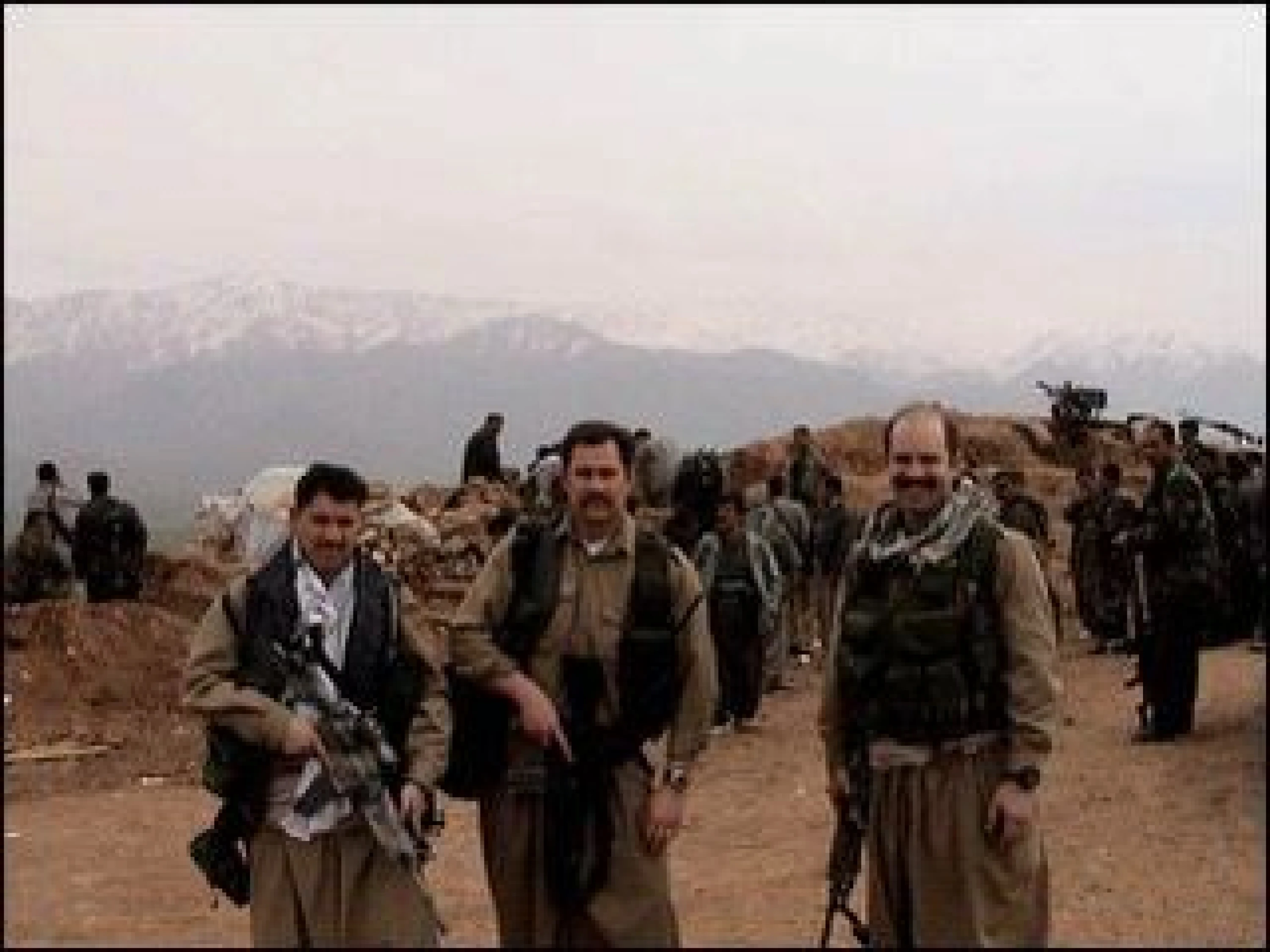
ERBIL, Kurdistan Region of Iraq – Former US Special Forces officer Mark Grdovic last year published Those Who Face Death: The Untold Story of Special Forces and the Iraqi Kurdish Resistance, recounting how US Special Forces, often dressed as Kurdish Peshmerga fighters, worked alongside Peshmerga forces to defeat Iraqi troops in Kirkuk in 2003.
Grdovic began as an Infantry Officer in 1989 and served with the US army for over 23 years, including 19 years as a Special Forces Officer. The last time he visited Kurdistan was in 2010.
As a former instructor at the Special Forces school, Grdovic said he decided to write about Kurdish Peshmerga-US Special Forces cooperation because he believes the experience could be valuable for future US military students.
“As the years passed, I was surprised how little the US military knew about this story. In hindsight, I’m not surprised, because the story of the invasion was pretty quickly eclipsed by a decade of brutal counterinsurgency that followed,” he told The New Region.
“In 2020, I was giving a presentation on the story, and again surprised how little people knew of the story. I also realized I was one of a very small group of people that knew the whole story beginning to end. So, in 2022, I just decided to start writing and finished the book in 2024,” Grdovic explained.
Grdovic also writes in the book that Iraq's insurgency could have been prevented had the majority of the Iraqi armed forces been integrated into the country's new security forces early on, rather than being disbanded.
“The original plan was always to retain most of the Iraqi army as part of the new Iraqi army. People would have paying jobs, get to stay with their families, keep their rank. All of this fell apart at the last minute, and the Baath party was outlawed and excluded from being a part of the new government or military, an incredibly stupid decision,” he said.
“It wasn’t until several months later that the foreign fighter flow [from Syria] started to increase. With the help of local Iraqis, the insurgency would never have been able to take root. But that’s not what happened. The US occupation forces didn’t understand what was happening in neighborhoods. The population grew increasingly frustrated and feeling disenfranchised.”
The book mainly chronicles the ground cooperation between the US Special Forces and Kurdish Peshmerga, which also led to the defeat of the Islamist militant group Ansar al-Islam in the Halabja area in March 2003 during Operation Viking Hammer, one of the first joint operations between Peshmerga and US forces that came before the operation in Kirkuk.
Around 10,000 Peshmerga troops at the time defeated the group with former Soviet-style weapons acquired by the US in Eastern Europe.
“The reality was that Ansar al-Islam posed the more immediate threat to the [Patriotic Union of Kurdistan] PUK,” Grdovic said.
“Close to half of the PUK’s forces were tied up just containing the threat they posed. If that threat continued to exist, the PUK would not have been able to assume an offensive posture against the Iraqi forces along the Green Line. Independently, the [Kurdistan Democratic Party] KDP or the PUK would likely not have posed enough of a threat against Saddam’s northern Army to compel him to keep his forces in the north and not counterattack south against the invasion forces.”
Moreover, he underscores that one of the lessons of the Iraq war is that while airpower is an important element of warfare, it has clear limitations in what it can achieve, which can also be seen by the recent US air campaign against Iran.
“At some point ground forces are always needed. The Peshmerga proved to be very capable forces. They understood the human dynamic on the ground in a way that we never could,” he said.
He also credits the Peshmerga's reputation as an effective fighting force with helping compel Iraqi forces to maintain strong defenses in the north.
“The reputation of the Peshmerga was an important factor. Their aggressiveness in battle was well known to the Iraqi forces, and rightly so; they were feared as a result of it. This was an important factor in compelling the Iraqi forces to maintain their defenses in the north and eventually abandon their positions.”
Furthermore, he also underlined the importance of leadership in battle. “If I say the Peshmerga was a very good fighting force, it’s largely because of their leadership at the unit level. I can honestly say the men in charge of the units that I worked with were very good leaders. They led by example, and it had the positive impact on their forces I’m talking about.”
After Kirkuk was liberated from the Baath regime, the Joint Special Operations Task Force (JSOTF) had plans to intern all the Peshmerga forces in a containment camp and monitor them, which Grdovic opposed, arguing that Kurds were not a problem, but partners of the US.
“This was a terrible and ridiculous concept crafted by people with no contact with the Peshmerga or appreciation for what they had done,” Grdovic said. “I think it was fueled by some misperceptions that were perpetrated by the Turkish military and other US military commands that didn’t have an accurate understanding of what was actually taking place on the ground.”
Finally, the Kurdistan Coordination Center (KCC) was established, where US forces, the KDP, and the PUK could periodically meet.
Although US Special Forces were already on the ground before the US-led Operation Iraqi Freedom began in March 2003, Grdovic writes that they only learned the operation had started through a live BBC broadcast.
“It might not be obvious or intuitive, but the details of an invasion [time and date] are of the highest secrecy. If that information was leaked, it could jeopardize the entire operation. US personnel operating from friendly territory who knew the details were kept to a minimum,” Grdovic said.
“I learned later that President [George W.] Bush made the decision to change it based on intelligence-related specific decisions reported to be made by Saddam Hussein. So, what became known as Shock and Awe was a surprise to me along with everyone else. I actually learned of it by watching a live BBC broadcast.”
Grdovic recounts in the book that while in Halabja, he unfurled a large US flag, prompting crowds to erupt in celebration. “That moment galvanized my commitment to do whatever I could to accomplish our mission,” he wrote.
Grdovic argues that without Operation Iraqi Freedom, which overthrew Saddam Hussein in 2003, it is unlikely Saddam would have continued to tolerate Kurdish autonomy in the Kurdistan Region.
That autonomy had been established under the protection of the no-fly zone imposed in 1991 and was only later formally recognized in Iraq's 2005 constitution after the Baath regime was toppled. This is one of the reasons why many Kurds still remember President Bush positively.
“It’s my opinion that Saddam fully intended to eventually return to a degree of sovereign control similar to before the 1991 Gulf War. It was necessary following the Gulf War that he had to reluctantly accept some degree of Kurdish territorial autonomy,” Grdovic said.
Looking back two decades after the war, Grdovic underlines that the success of the US campaign in the north was based on the partnership with Peshmerga forces.
“We developed a real partnership. We worked as partners and respected each other as such. We understood that there are two halves to every partnership. We approached the partnership with a sincere willingness to collaborate.”
Overall, Those Who Face Death offers a rare and detailed account of one of the most successful partnerships between US Special Forces and the Peshmerga during the 2003 Iraq War, helping to bridge an important gap in the historical relationship between the two.
 Facebook
 LinkedIn
 Telegram
 X
X