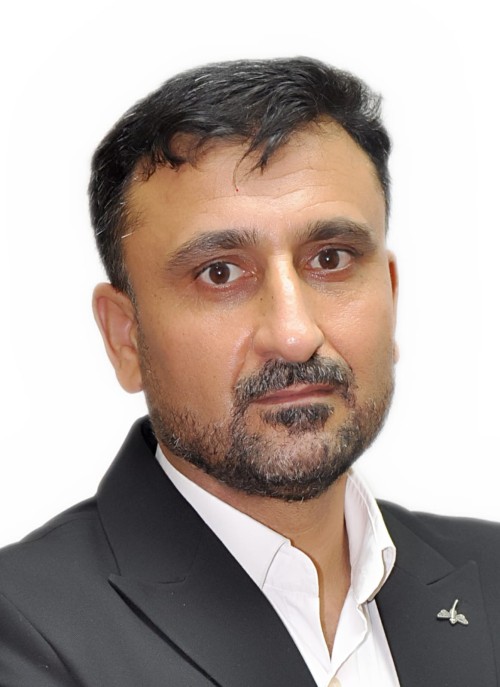
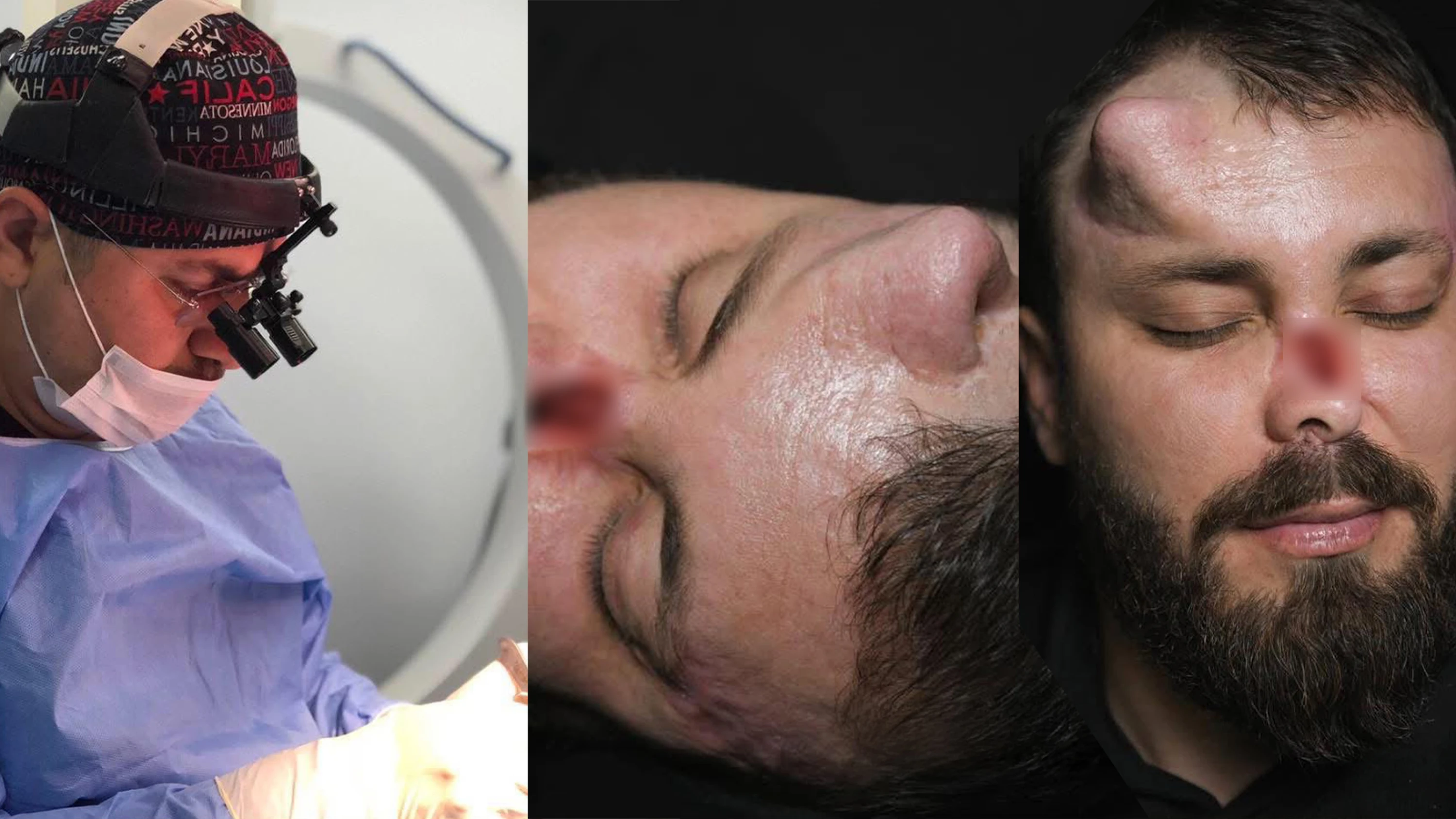
SULAIMANI, Kurdistan Region of Iraq – A spark of hope returned to Derin Wali Mahmoud when his doctor revealed an astonishing plan: a new nose could be crafted for him, right on his forehead.
For months, Mahmoud endured the physical agony and emotional wounds left by a devastating workplace accident that cost him his nose, dimmed his vision, and scarred his body. But now, after a series of intricate surgeries in Sulaimani, a new nose is slowly forming on his forehead, giving the 28-year-old from Halabja a glimmer of hope to reclaim the life he once knew.
Mahmoud, who comes from Kheli Hama village, completed his studies in the Pharmacy department at a local technical institute in 2021. Together with hundreds of thousands of other young unemployed people all over the Kurdistan Region, he had difficulty in finding stable employment due to the difficult economic situation and the high level of unemployment which resulted from successive Iraqi governments’ detrimental policies towards the Kurdistan Region.
He eventually took up a job as a laborer with a private company in Halabja province, putting aside his dreams in order to secure financial stability.
He explained to The New Region how his difficulties started, blaming the company's neglect of safety procedures for putting his life in danger.
“When working on the Halabja city entrance project on March 17, 2025, I received a severe electric shock from an 11KV high-voltage line since the company had not implemented the necessary safety precautions,” Wali recalled on the phone. “The shock caused my nose to be burnt off, and badly affected my eyes, and I have undergone two surgeries so far.”
The accident occurred when Mahmoud was asked to carry out a task which was well beyond his normal duties.
He said that an engineer had asked him to get onto a loader and cut the high-voltage lines situated between Halabja and Sirwan town.
“Although that was not part of my duties, I still offered my help as a sign of goodwill. I was able to cut two of the lines safely, but with the third one, the power was suddenly switched on. There had been no proper communication between the company and the directorate of electricity, and as a result, I suffered serious injuries and had to remain in intensive care for three days,” Mahmoud said.
The electric shock left Mahmoud’s face unrecognizable. His nose was gone, his vision impaired, and his left leg and shoulders bore the scars of severe burns.
At first, the company owners and local authorities showed sympathy. They promised to pay for all his medical and surgical costs, even if he needed treatment abroad, and said they would give him a monthly salary of 400,000 Iraqi dinars while he recovered.
Those promises persuaded Mahmoud not to file a legal complaint.
Despite what he says was negligence by the company, Mahmoud chose not to take legal action, citing tribal customs and communal ethics. He also declined to name the company publicly, saying he wanted to uphold his sense of honor.
But when Mahmoud needed their support most, the company turned its back, refusing his plea for compensation.
Mahmoud and his family had to bear the heavy burden of medical bills. Nevertheless, he stated that the greatest suffering was not due to any loss of money or of his profession, but rather came from the disturbing fear of living forever without a nose.
From despair to hope
Several months after the accident, Mahmoud sought help from a local ear, nose, and throat physician in Halabja. The doctor referred him to Dr. Diyar Abdulwahid, a plastic and reconstructive surgery specialist in Sulaimani.
By that time, Mahmoud was battling the emotional aftermath of his injuries, dreading the thought of facing the world with a changed face.
“I was in a dreadful state, psychologically tormented and constantly wondering how I could ever face life without a nose,” Mahmoud recalled. “Thankfully, the esteemed Dr. Diyar gave me hope and lifted my spirits. He first performed several surgeries to clean the burns and treat the severe infections. Then, he suggested crafting a new nose, either with plastic or, incredibly, by growing a natural one on my forehead so it would eventually match my skin tone.”
The proposal was nothing short of extraordinary. Rather than relying on artificial materials, Dr Abdulwahid would sculpt a new nose from Mahmoud’s own tissue and cartilage, letting it grow on his forehead before moving it to its rightful place.
The new nose was painstakingly constructed from Mahmoud’s own rib cartilage.
Abdulwahid embarked on the intricate journey in careful stages, encouraging Mahmoud to hold on to patience. The process demands time for the tissue to heal and mature before the final transplant.
Mahmoud shared that the doctor performed the surgeries without charge, leaving him only the hospital expenses to cover. He described Abdulwahid as a beacon of kindness and support during his darkest days.
So far, the surgeries have been a success. Within the next two months, Mahmoud will face the final stage, when the nose growing on his forehead will finally take its place on his face.
The New Region spoke with Dr. Abdulwahid, who said the procedure is the first of its kind to be carried out in Iraq and the Kurdistan Region.
“The patient’s nose was burnt by electric shock; there were no other solutions except to create a new nose on his forehead, and thanks to God, the surgery has been successful so far,” Abdulwahid explained. “Two more surgical stages remain. From now on, such nose-planting procedures can be done right here in the Kurdistan Region.”
In 2013, Chinese doctors planted a nose on the forehead of a 22-year-old man who had suffered severe nasal trauma following a traffic accident. A similar operation was conducted on a 12-year-old boy in India in 2016.
For Mahmoud, this surgery is more than a medical milestone. It is a lifeline to restore his confidence after months spent in the shadows of pain and uncertainty.
Now, whenever Mahmoud steps outside, curious eyes follow him. Strangers ask about the nose on his forehead, their questions making him feel exposed and uneasy, a constant reminder that his healing is on public display.
Yet Mahmoud, who now awaits his last surgery, continues to hope. His story is one full of hardships, but at the same time, one about medical innovation, resilience, and a young man who refuses to give in to despair.
 Facebook
 LinkedIn
 Telegram
 X
X