
BAGHDAD, Iraq - The ongoing investigation into a drone manufacturing workshop seized in Baghdad last month has identified five commanders of Iran-backed Shiite armed factions as key customers of a drone supplier, Iraqi security officials told The New Region.
An operation carried out by the Iraqi National Security Service (INSS) on July 21 resulted in the seizure of a workshop used to manufacture and assemble combat drones, the arrest of three workers, and the confiscation of 25 drone frames, carbon-fiber panels, components, and technical equipment used in the production process, according to a statement from the INSS.
Drone attacks have emerged as one of the biggest security challenges facing Iraqi authorities in recent years. More than 700 drone attacks targeting US interests, military bases, company facilities, and government and private sites in the Kurdistan Region were recorded between February 28 and April 20, according to Kurdish officials.
Most of the attacks were carried out by Iran-backed armed groups.
Although security officials described the operation as medium in size and significance, dismantling a drone manufacturing and assembly cell reinforced the momentum of the campaign launched by Iraqi Prime Minister Ali al-Zaidi in June to restrict weapons to the state.
The investigation into the seized workshop revealed that it was not affiliated with any of the Iran-affiliated armed factions active in using drones. It also established that the drones were smuggled into Baghdad as components, then assembled and modified at the workshop before being supplied to customers, officials told The New Region.
“The workshop does not belong to any of the known armed factions. It was producing drones and selling them to several parties,” a senior security official familiar with developments of the investigation told The New Region.
Investigators identified the main supplier of raw materials and spare parts used by the workshop to produce drones, tracked him down and arrested him early this month, officials said.
Three security officials from three different Iraqi security agencies confirmed the supplier’s arrest, but accounts regarding the exact date and location of the arrest remained conflicting.
It is not yet clear whether the supplier is the owner of the seized workshop or was solely its supplier, nor is it clear what internal or external connections he had. Initial information suggests that he was working for pay, officials said.
“So far, the results of the investigation suggest that he [the supplier]h ad been providing drones for financial gain rather than on behalf of a third party or for an ideological or political purpose,” a senior security official familiar with the progress of the investigation told The New Region.
“He was a valuable catch and revealed many details about his clients and the smuggling and supply networks associated with him.”
The customer list
Drones have become one of the most sought-after and desirable modern weapons among armed factions in recent years due their low cost, ease of transport and storage, and effectiveness.
Iraqi armed factions affiliated with Iran have sought to diversify their sources of these weapons and develop them to increase their flight range, maneuverability and explosive payload.
The fact that most of these factions do not possess their own drone manufacturing facilities, due to the high costs, their inability to attract qualified experts, and the reluctance of Iran to supply them with the latest generations of these aircraft, has pushed them to seek alternative sources of equipment.
The drone manufacturing and assembly workshop seized by INSS units in the Baladiyat neighborhood, east of Baghdad, was one such source of equipment, officials told The New Region.
During his interrogation, the supplier of the seized workshop disclosed the names of his customers, identifying five commanders of Iran-backed armed factions as his key customers, officials said.
Among those customers were Akram al-Tamimi, director of the PMF’s Technical Combat Support Directorate and a prominent commander of Kataib Hezbollah, and Abbas al-Yaqoubi, chief of the intelligence unit of the PMF’s Baghdad Belt Operations Command and a prominent commander of Harakat Hezbollah al-Nujaba. Another three commanders were also identified, two of them belonging to Kataib Sayyid al-Shuhada and the third to Kataib Hezbollah, a senior PMF official told The New Region.
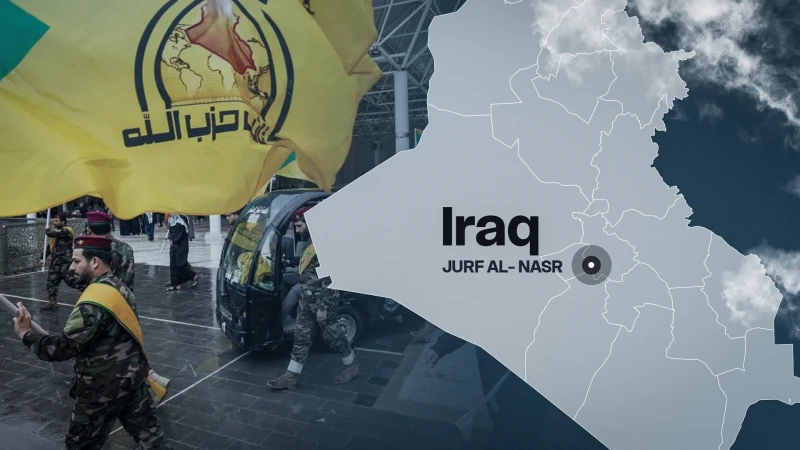
Kataib Hezbollah, Harakat Hezbollah al-Nujaba, and Kataib Sayyid al-Shuhada are three of seven Iran-backed Shiite armed groups that operated for years under the umbrella of what was known as the Iraqi Resistance Coordination. However, they have become the backbone of what is now known as the Islamic Resistance in Iraq following the dissolution of the Iraqi Resistance Coordination in May.
The group has claimed responsibility for hundreds of drone attacks against US targets in Iraq and the wider region during the recent US-Israeli war against Iran.
Although the five commanders are officially registered on the PMF payroll system, they were operating independently with the seized workshop, officials said.
“He listed the names of his key customers, including the five commanders,” the PMF official told The New Region.
“He clearly admitted that his relationships with them were individual and merely commercial.”
The five men were separately arrested over the past two weeks by an INSS force backed by a Counter-Terrorism Service force, based on judicial arrest warrants, officials said.
The arrest of Yaqoubi on August 17 at his home in Dhi Qar province, 400 km south of Baghdad, provoked the three factions and nearly led to an armed clash between them and the Iraqi government.
However, the intervention of leaders of the ruling Shiite Coordination Framework and an agreement reached between the two sides defused the crisis.
All the concerned parties agreed that the arrest of any PMF fighters or commanders for investigation should not be carried out without informing or coordinating with the PMF Security Directorate, PMF officials told The New Region.
The arrest of Tamimi and the three other commanders on Monday also sparked major controversy. PMF commanders said the Monday arrests were carried out without informing or coordinating with the Security Directorate.
The command of the forces that carried out the arrests stated that the arrest warrants they executed contained no information indicating that the wanted individuals were members of the PMF and that they therefore saw no justification for contacting the PMF Security Directorate, officials said.
“The investigating judge was unaware that they were affiliated with the PMF because the information he received did not indicate their military affiliations,” a senior PMF official told The New Region.
The five suspects were later handed over to the PMF’s Security Directorate and released.
“Their [the five men] legal status has been settled with the judiciary,” the official said without providing further details.
“The investigation into the main case is still ongoing and may lead to other new names. We hope that any future arrests will be coordinated with PMF security to avoid any escalation.”
 Facebook
 LinkedIn
 Telegram
 X
X