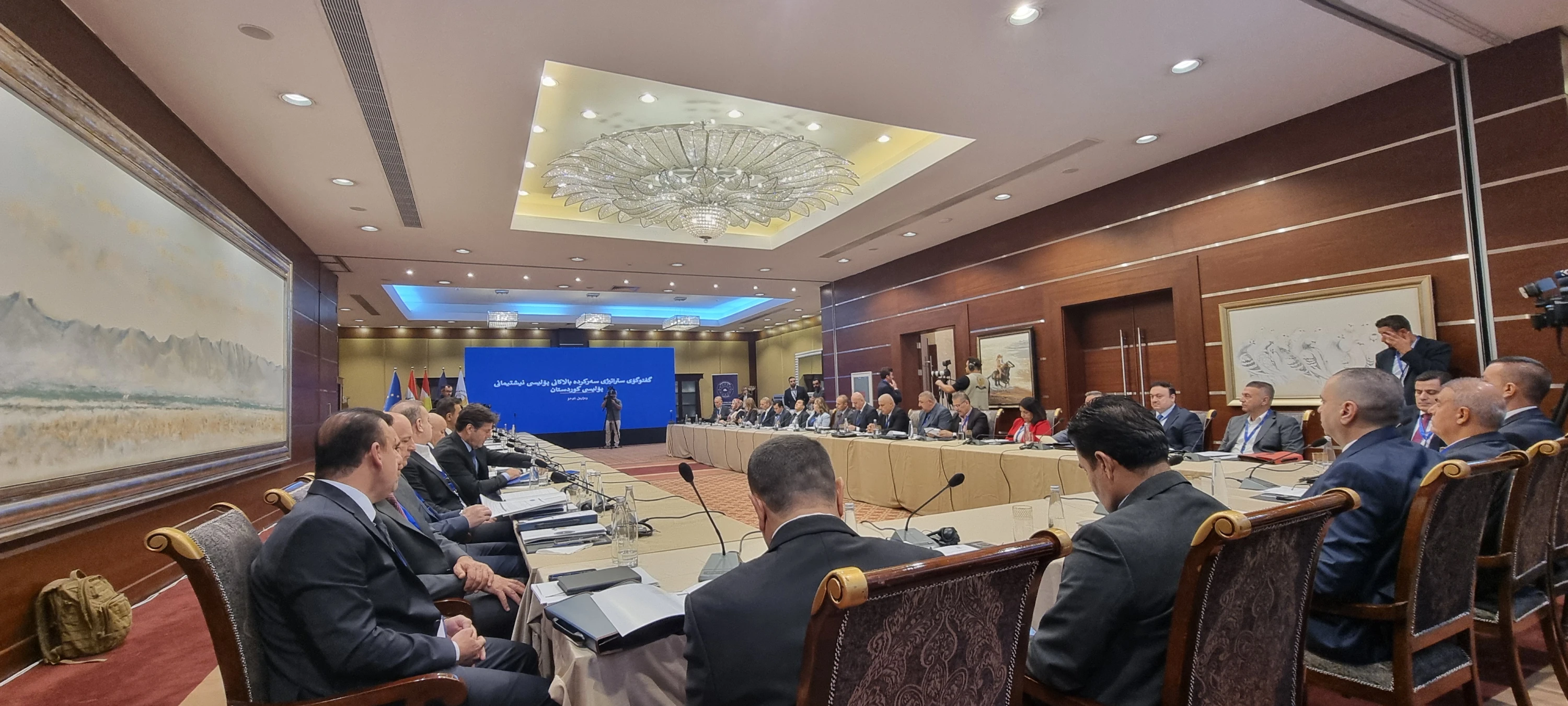
ERBIL, Kurdistan Region of Iraq - While the Ministry of Peshmerga’s reform project to unify and modernize Peshmerga forces receives a lot coverage, very little is known about a project by the Kurdistan Regional Government’s (KRG) Ministry of Interior aiming to reform Kurdish police forces by 2030, in a campaign backed by European advisors.
On Sunday, senior leaders of the Kurdistan National Police met to discuss progress in Kurdistan Police Reform Strategy 2026–2030, at a workshop also attended by European advisors. Moreover, from August 23 to August 26, a high-level delegation by the interior ministry and EU advisors also visited police stations in Duhok, Erbil and Sulaimani.
While the Peshmera reform project aims to integrate the Kurdistan Democratic Party’s (KDP) Unit 80 and the Patriotic Union of Kurdistan’s (PUK) Unit 70 into the Ministry of Peshmerga, the police reform project aims to modernize the police.
KRG Interior Minister Reber Ahmed at the workshop told police leaders that the police serve all people of the Kurdistan Region. “We are the police of Kurdistan, not the police of the KDP or PUK. We need to get out of that mindset. Embrace Kurdistan as a whole and do your best to serve it.”
Brigadier General Ralf Schroeder, Head of Mission of the European Union Advisory Mission in Iraq (EUAM Iraq), told The New Region on Sunday that they are supporting this process all over Iraq. “Our mission headquarters is based in Baghdad, and we are working together with federal Iraq and also with the Kurdish police here on very similar topics.”
Schroeder added that they also cooperate with the internal security forces (Asayish), but not as part of a project led by the KRG interior ministry. “We're working and cooperating with Asayish also in other areas, but not in this specific project.”
He also told reporters at the event that the mission has nothing to do with the Coalition mission that is set to end in late September, and that their mission will continue for at least two more years.
Rondak Faris, head of the KRG’s Ministry of Interior's Leadership and Management Academy, said at the workshop that so far they developed a local training concept and strengthened the skills of local trainers, leading to the successful training of more than 10,000 police officers.
“These practical steps have been successfully implemented across the Kurdistan Region, including Erbil, Duhok, Halabja, and Sulaimani. This is an important step forward.”
However, she added that there are not enough women in the police leadership.
“This is an opportunity for the leaders of the Kurdistan police to increase the status of women, from participation to leadership,” the interior minister added. “The current steps should create real opportunities for women to develop their capabilities, participate in decision-making, and use their full capacity. This is not simply an option; it is a necessity for a strong police institution.”
Dutch Brig. Gen. Saman Hassan, a police director working in western Netherlands who spoke at the workshop about the history of the Dutch police, also underlined the need to include women in the police force, noting that women currently hold 49 percent of senior positions in the Dutch police.
“As I simply said: you have 50 percent of society who are highly capable: women. So it is extremely foolish not to make use of them, because if you use only 10 percent of the 50 percent who are men, so to speak, then you are wasting the rest,” he told The New Region.
“You can essentially measure a society by looking at how women are positioned within it. And I also explained that giving women a position is not a gift that we are giving them. No, we need to support them. But the reality is that they are there, and they should have a position as well.”
The KRG interior minister also expressed appreciation to the EU Advisory Mission in Iraq during the event.
“Strategic advice from EUAM is an opportunity to enrich our vision with international experience. But this vision must come from the reality of Kurdistan, from the leaders of the Kurdistan police, and be reflected and deeply rooted in our institutions,” Ahmed said. “Your presence today is important for the future of the Kurdistan police.”
Schroeder agreed. “The reform process can only work if it is owned and driven by the authorities going through the process. We are not going through this process to push it externally. We are happy to provide our support, advice, and experience, but you make the decisions about what you need in this process.”
Ahmed also underlined that the next phase in police reform should be a strategic investment in programs and police colleges, human resources, and technology, including educational curriculum not only for police officers, but also as a platform for officers and leadership to learn skills in management, decision-making, and technology.
“This should become part of our institutional power, a power for evidence-based decision-making, forecasting criminal activity, and strengthening investigations. We also need the renewal of our tools.”
Hassan, who worked in the Kurdish Asayish before he went to the Netherlands, also compared the different mentalities in Dutch and Kurdish police. “Based on what you have seen so far, is that in the Netherlands, we approach things from the perspective of the individual’s capabilities: What can you do,” he said. “We make use of people with specific knowledge and expertise.”
However, he said the Kurdistan hierarchy is very strong. “Someone who has a lot of knowledge and is able to make a decision but is at the very bottom of the hierarchy has to wait a very long time until the highest-ranking official decides what should be done, and only then can that person go back and take action. So, that is one difference.”
“I think the leadership here has done many good things over the past few years. But I think it is time for a new type of leadership. And by ‘new’, I do not mean that these people have to leave. Rather, they really need to adapt to a new leadership approach, where you realize that you are part of the team, not the boss of the team.”
Therefore, Hassan said that the biggest obstacle to police reform is police culture and the mindset of the management layer at the top is an obstacle.
“That is also about cultural change. It is about organizational knowledge, understanding how departments work and how information is shared among each other. This is very limited, and there needs to be much more openness toward the outside world,” he said.
Nevertheless, he added that we should not forget that the situation of the Netherlands and the Kurdistan Region is very different. “We have had 80 years of peace and stability to get this far. They are still dealing with instability every day. There is no salary, no oil, no gasoline. There is Turkey, Iran, Baghdad. So political instability does not help either.”
Major General Tariq Ahmed, Director General of the Kurdistan Region Police, also stated that the project has enabled them to “prevent tens of thousands of crimes before they are even committed and to detain perpetrators in the shortest possible time,” stressing the importance for every police officer to undergo the training.
“I also ask all police officers to study the project. Any comments or feedback will be welcomed, discussed, and analyzed so we can continue to improve it. We, as police officers, must work together to ensure this project succeeds,” he concluded.
 Facebook
 LinkedIn
 Telegram
 X
X