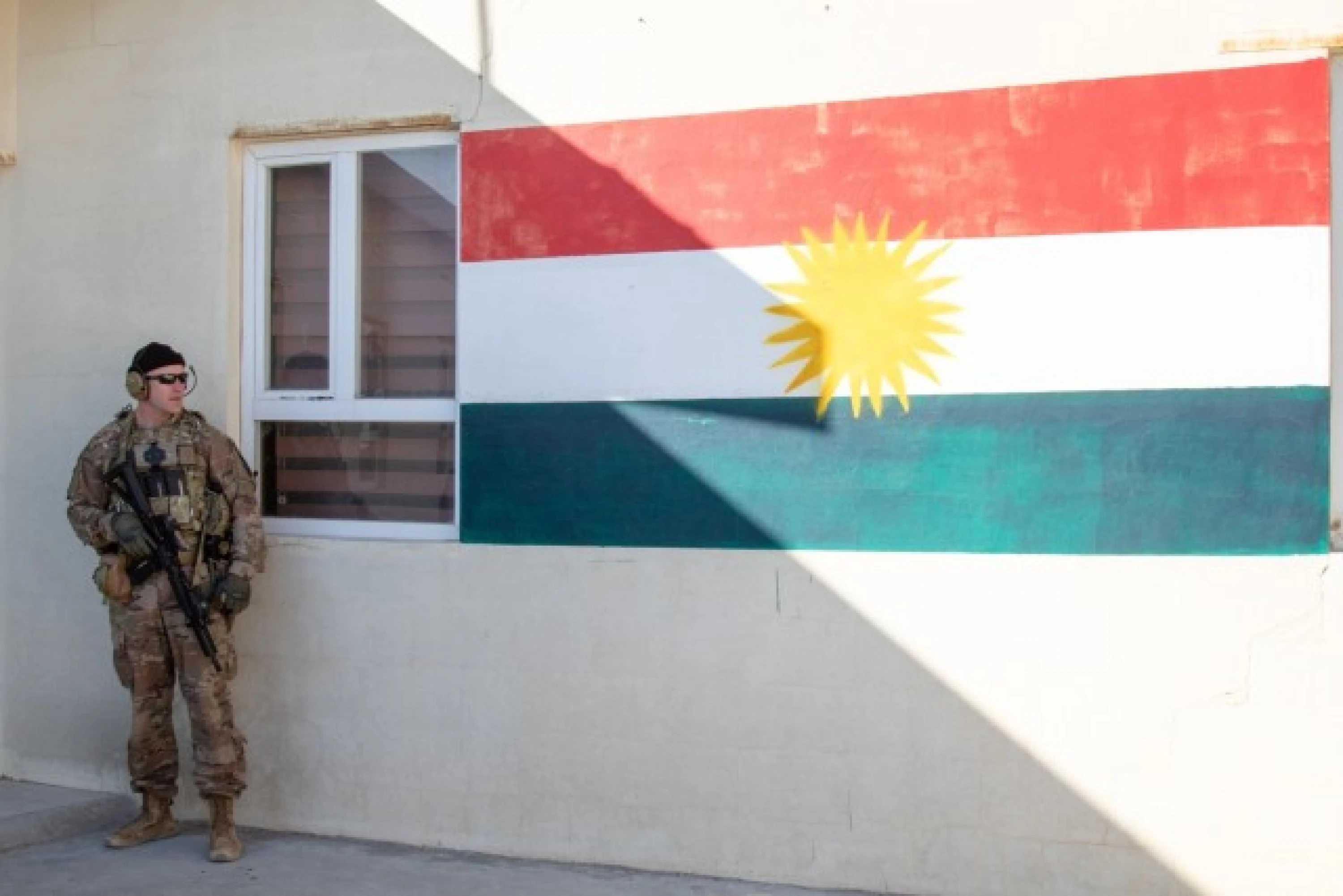
ERBIL, Kurdistan Region of Iraq - The Memorandum of Understanding (MoU) between the US Department of Defense and the Kurdistan Regional Government (KRG)’s Ministry of Peshmerga Affairs is set to expire in the same month as Coalition forces are scheduled to leave the Kurdistan Region in September, raising questions regarding the future of a storied bilateral security relationship.
In 2022, Erbil and Washington signed a four-year MoU that secured renewed US support for the Peshmerga and charted a course for the unification of partisan, politically-aligned components under an integrated command.
The latest report from the Pentagon's Inspector General, published on August 25, noted that the current MoU for advisory support with the Peshmerga Ministry is due to expire in September after a previous extension, though the United States will be able to continue support after that date. The BBC also reported this week that the US is not expected to extend the MoU, this despite a request by the Ministry of Peshmerga.
“The US Government's financial support to the Kurdistan Regional Government for the unification of the Peshmerga forces was always intended to be temporary. It was intended to help the Ministry of Peshmerga Affairs integrate and unify the different units, and if the US Government is now ending the payment of stipends to those forces, that is almost certainly because it judges the unification effort to be complete,” Ambassador Joey Hood, the former US Acting Assistant Secretary of State for Near Eastern Affairs, told The New Region.
“No diplomatic engagement remains static; it must evolve with the circumstances, and that is what is happening between the US Government and the Kurdistan Region,” he added.
A new phase of cooperation
The Inspector General report also cites United States Central Command (CENTCOM), which assessed that, while the KRG is making progress on Peshmerga reform, “it is not yet capable of fully absorbing responsibilities previously supported through CTEF (Counter-ISIS Train and Equip Fund),” which supported the Kurdish forces at the height of the fight against the Islamic State (ISIS).
“The Kurdistan Regional Government’s capacity to independently manage training, readiness, and salaries is considered limited and uneven,” CENTCOM assessed.
Moreover, the US Defense Intelligence Agency (DIA) noted in the report that deep-seated partisan divisions undermined “slow progress toward the creation of a unified, non-partisan security force.”
Retired US Army Colonel Myles B. Caggins III, former spokesman for the anti-ISIS Coalition and a senior nonresident fellow at the New Lines Institute, asserted that the end of the Coalition to defeat ISIS in Iraq and Syria is not the conclusion of foreign military support and advice to Iraqi and Kurdish security forces.
“Future collaborations will shift from long-term deployments with significant logistical resource requirements to short-term mobile military training teams and partnership exercises.”
“Peshmerga will continue to send a handful of officers to professional military training courses in the United States and Europe. Efforts to unify the Peshmerga should still continue and will benefit all people of Kurdistan Region; this is an internal matter for the KRG to finalize and it should lead to future military aid from the United States.”
Iraqi government spokesperson Haider Al-Aboudi on Monday said that the Iraqi Prime Minister had rejected a proposal to retain some International Coalition forces in Iraq beyond September 30. It is unclear whether this proposal came from the United States or another country that is part of the Coalition.
David Witty, a retired US Army Special Forces Colonel and Foreign Area Officer, told The New Region that it would be difficult for other Western countries to maintain a large presence after the US withdraws.
“The US provides a lot of enablers and air defenses. However, there could be small, decentralized teams of trainers and advisers from European countries. But they would need to be dispersed and away from likely targets such as the US consulate and the Harir Airbase.”
On July 14, US Secretary of Defense Pete Hegseth, during the visit of Iraqi Prime Minister Ali al-Zaidi to the United States, also underlined that the Coalition mission will end by September 30, 2026.
Iraqi Prime Minister Ali Faleh Al-Zaidi on August 24 also met Commander of German Forces Deployed Abroad, Gunter Schneider, where they discussed the withdrawal of Coalition forces and on August 25 officially announced the closure of their camp in Erbil.
“The relationship with the KRG and Peshmerga predates the Iraq War and the fight against Daesh (ISIS). Bilateral agreements with the central government in Baghdad will be an essential part of what happens next,” Alex Plitsas, a Nonresident Senior Fellow at the Atlantic Council, who previously worked in the US Secretary of Defense’s office, told the New Region.
So far, sources contacted by The New Region suggest that no country has signed any new bilateral agreement to keep military advisors in the Kurdistan Region or the rest of Iraq. However, the NATO mission in Baghdad continues.
“European partners are determined to continue advising the GoI [Government of Iraq] in the framework of NMI [NATO Mission Iraq]. Which shape, timing and size this will take is yet to be determined,” a European diplomat told The New Region.
READ MORE: NATO mission to open Baghdad office: Official
The current NATO Mission is only focused on Baghdad and does not include the Kurdistan Region and it is unclear if NATO advisors could also operate in the Kurdistan Region in the future.
The New Region earlier reported that NATO is planning to open a new office in Baghdad. In the past, it was based at Camp Victory, an US military facility adjacent to Baghdad International Airport, that was targeted during the war between the US and Iran.
READ MORE: Kurdistan Region wants to stay out of war, PM Barzani reasserts
The drone threat
The withdrawal leaves the Kurdistan Region, which lacks substantial anti-drone defenses, vulnerable to possible drone attacks, analysts say. The Kurdistan Region was subjected to more than 1,000 missile and drone attacks since the war began in late February, KRG Prime Minister Masrour Barzani told Al Jazeera last month.
“The KRG is most vulnerable to Iranian drone and missile strikes, and helping the KRG to defend against those types of attacks is paramount,” Nicholas A. Heras, Interim Executive Director of the Middle East Policy Council (MEPC) told The New Region.
“The US does not have a plan in place at this stage for that type of support, and that should be the focus of future US-KRG security cooperation.”
Treefa Aziz, the KRG Representative to the United States, told The New Region that the KRG-US relationship in the end is not defined by a single MoU or the presence of Coalition forces.
“It is a longstanding partnership built on decades of cooperation, shared interests, and strong ties between our peoples. Whatever changes may come in the security framework, we remain committed to strengthening our relationship with the United States across security, economic, diplomatic, and people-to-people engagement,” she concluded.
 Facebook
 LinkedIn
 Telegram
 X
X