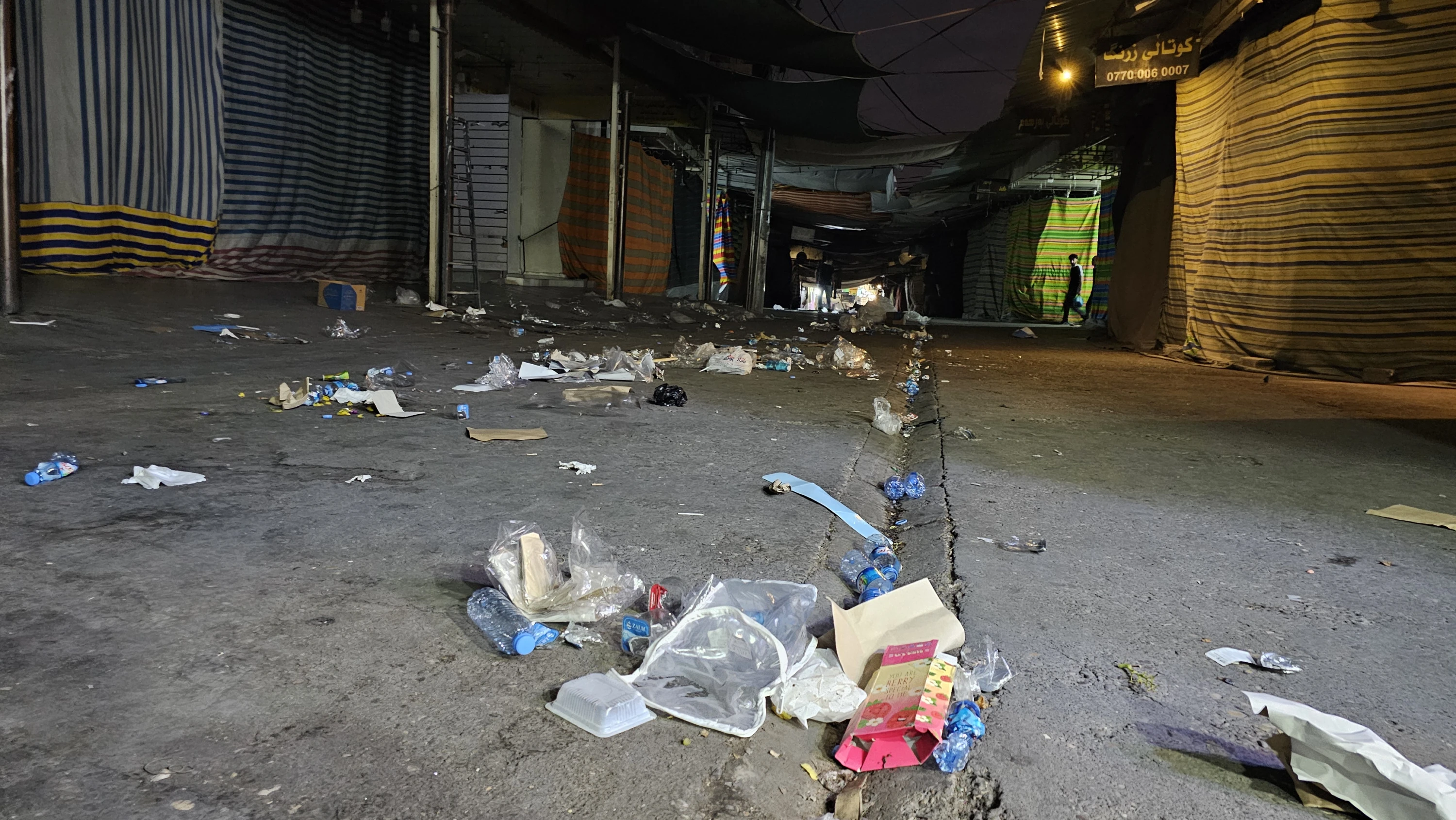
SULAIMANI, Kurdistan Region of Iraq - Municipal workers who sweep Sulaimani’s streets say they are still underpaid, lack insurance, and live in crowded caravans. Meanwhile, a dispute over old contracts has put the government’s new minimum wage on hold.
By 5 am, before shoppers and cars fill Sulaimani’s bazaar, the city’s street cleaners are already at work.
They sweep the sidewalks, pick up rubbish, and clear away debris left from the day before. By the time cafés open and shops lift their shutters, most of their work is finished and goes unnoticed. Workers say they still have not seen the government’s promise of better pay put into action.
Earlier this year, the Kurdistan Regional Government (KRG) set a minimum monthly wage of 450,000 Iraqi dinars, or about $305, for cleaning workers based on an eight-hour workday. However, interviews by The New Region show that many workers in Sulaimani still get less. Some receive 400,000 dinars, while others get only 350,000 dinars.
Across the Kurdistan region, local administrations in cities and towns sign contracts with private companies to collect trash and keep the streets clean. In Sulaimani, six private companies each handle cleaning in different parts of the city.
For workers who live paycheck to paycheck, this difference is not just paperwork. It can mean the cost of a trip home, a month’s worth of food, or being able to send money to family.
“I receive 400,000 Iraqi dinars per month. It is not enough for me,” said one street cleaner, who did not want to be named. He is from Mosul and works in Sulaimani’s central bazaar because he says there are few jobs in his hometown.
He said a round trip to visit his family costs about 70,000 dinars, almost a fifth of his monthly pay. He has not seen them since last September.
A wage floor that has yet to reach everyone
The worker, who is also a university student, said he and his coworkers sleep in caravans provided by the company. “Each caravan accommodates 20 people,” he said. He does not have social insurance, even though the law says employers must register workers.
For him, getting 450,000 dinars would not change his life completely, but it would help. “It would lessen our misery,” he said.
Mohammed Ahmed, a sweeper who has worked in Sulaimani since 1998, has a similar story. He also earns 400,000 dinars a month and says the living conditions are cramped and uncomfortable.
“There is no cooling system inside the caravans,” Ahmed said. “We start work at 5 am and finish at 2 pm. We are asking for higher salaries.”
The shift he describes is longer than the eight-hour workday set by the government. For many workers, the problem is not just the hours but also the question of what 400,000 dinars can buy in a city where rent, food, and transport keep getting more expensive.
A Kurdish municipal worker, who also did not want to be named, said he gets only 350,000 dinars a month. He said only two Kurdish workers remain among the cleaning staff, while most now come from Arab-majority areas, especially Mosul.
A Kurdish garbage truck driver, who spoke on condition of anonimity, said he earns 500,000 dinars a month. This is a bit more than the new minimum, but still low for work that is physically demanding and essential to the city.
These pay differences show a system where workers doing similar jobs can earn very different salaries. It depends on which company hires them, their contract, and their job in the municipal workforce.
The contract argument
At the heart of the dispute is a common conflict between public policy and private contracts.
Shenky Company, one of the private contractors working with Sulaimani municipality, says it pays its workers 400,000 dinars a month and cannot immediately absorb the increase required by the government decision.
“Our bid, before winning the contract with Sulaimani municipality in 2023, was based on 400,000 dinars,” said Amanj Husamaddin, the company’s director of projects. “We currently have 400 workers, and if we increase 50,000 dinars for each worker, we will suffer a big loss.”
Husamaddin said the company’s current contract is due to end by the end of this year, and that the 450,000 dinar wage would be incorporated into future tenders.
He said most workers and drivers had been enrolled in social insurance, but that temporary workers had not been included. For these temporary workers, their situation remains unclear. Without social insurance, they are not eligible for the security and benefits that come with it, such as coverage in case of injury or illness.
While they receive meals, accommodation, and transportation from the company, these do not replace the legal protections or recourse available to registered employees, leaving temporary workers with few options if they face workplace problems or are injured on the job.
He also said the company has been fined several times for child labor, but has now stopped doing so.
He said the reason behind hiring child labor, between the ages of 16 and 17, was due to a shortage in workforce after the repatriation of internally displaced people from Arbat Camp.
This explanation shows there is a gap in the system. Workers may have to wait for old contracts to finish before they get higher pay. For companies, the increase is a financial burden not covered by old deals. For workers, it raises the question of whether a minimum wage is really a minimum if it can be delayed.
The Ministry of Labor and Social Affairs takes a firmer view. Bestun Jabbar, the ministry’s spokesperson, said the decision was binding on all companies from the date it was issued.
“We will take strict legal measures against any company or business owner that is not abiding by the pay increase decision; it is binding for all,” Jabbar told The New Region. “The minimum wage for unskilled workers is 450,000 dinars, and workers should complain to us if they are paid less than that.”
Workers can file a complaint by visiting a local office of the Ministry of Labor and Social Affairs or by calling the ministry's hotline. The ministry also offers support through legal advisors who can help workers submit complaints or represent them in labor court. In many cases, workers may bring supporting documents such as their contract or pay slips. Jabbar encouraged anyone facing issues to contact the ministry directly for guidance and assistance.
He said the ministry had hired lawyers to defend workers’ rights in labor court. Companies claiming that implementation would cause financial losses should present evidence to the ministry’s legal departments, he said.
A policy open to interpretation
The position from Sulaimani municipality appears more tolerant. Karzan Abdulrahman, the head of garbage collection, said the new wage applies to contracts signed between workers and private companies after June 1.
But the official government document seen by The New Region does not appear to set out such an exemption. It says that in contracts between the KRG and private companies, sufficient funds should be allocated to pay each cleaning worker 450,000 dinars for eight hours of work each day.
That distinction matters. If the government considers the decision immediately binding, but local authorities treat existing agreements differently, workers may find themselves caught between competing interpretations of the same policy.
Osman Zindani, head of the Housing Workers Syndicate, said the pay-raise decision followed years of pressure from labor unions.
“Setting the minimum wage at 450,000 Iraqi dinars, in line with living costs and people’s basic needs, is a positive step,” he said. “Although the cost of living actually requires more than this amount.”
Zindani said some companies had objected because they submitted tenders based on lower wages, in some cases 350,000 dinars. He said unions had asked for an interim arrangement until those contracts were completed, but argued that the 450,000 dinar wage should be fully enforced from 2027.
Even that amount, he said, is not enough for what workers really need.
The question of pay is inseparable from social security. Under Iraq’s Pension and Social Security Law No 39 of 1971, employers are required to register workers and contribute to the social security system. The protections are meant to cover workers during illness, disability, old age and death -- risks particularly relevant to people whose work involves heavy lifting, traffic, waste and exposure to extreme weather.
Protection on paper
“Social security is a legitimate right of the working class,” Zindani said. “No worker should work without it.”
Official figures show that nearly 320,000 workers are registered in the Kurdistan Region’s social security system, with more than 1,000 already retired. In June, the KRG Council of Ministers set a minimum monthly pension of 500,000 Iraqi dinars for retired private-sector workers.
But stories from municipal workers show that registration is still uneven, especially for temporary and contract workers.
Kurdistan’s parliament passed a new labor law in 2023, promising stronger protections, including limits on working hours, workplace safety measures and safeguards against forced and child labor. Employers are also required to contribute 17 percent of a worker’s monthly salary to the Social Security Directorate.
On paper, the rules look strong. But on the streets of Sulaimani, workers say their situation is much less secure.
The city depends on these workers every day, but their efforts are mostly unnoticed unless rubbish piles up or streets are left dirty. People often call their work low-skilled, but it requires long hours, physical strength, and a willingness to do jobs that others avoid because of low pay and social stigma.
For the cleaner who has not seen his family in Mosul for almost a year, the debate over contracts and rules has a direct impact. It decides whether he can afford to visit home.
A 50,000 dinar raise may seem small on a government spreadsheet. For Sulaimani’s municipal workers, it shows whether the city’s promise to value their essential work is more than just words. Looking ahead, unions and advocacy groups are expected to keep pressing for full enforcement of the wage increase, while legal action remains an option for workers denied their rights.
The government has also said it will continue reviewing contracts and monitoring company compliance. As the debate continues, workers and supporters hope that their voices will help bring lasting improvements to pay and protection across the region.
 Facebook
 LinkedIn
 Telegram
 X
X