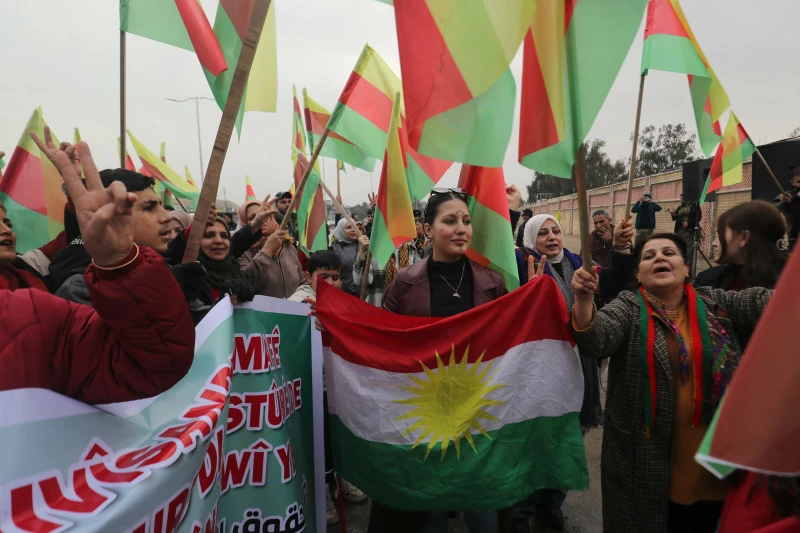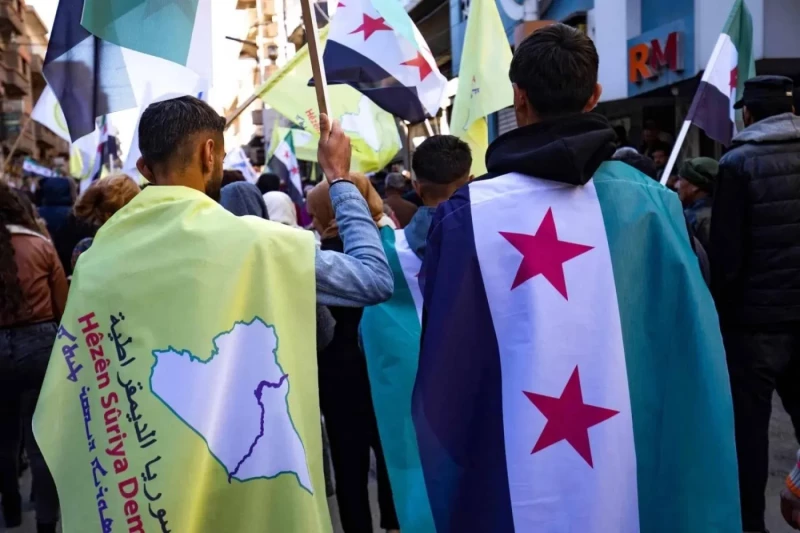
On August 25, an announcement from the Syrian capital, Damascus, sent shock waves among Kurds in the region and diaspora. General Mazloum Abdi officially declared the dissolution of the Syrian Democratic Forces (SDF) under his command. The multi-ethnic and multi-religious force was once the tip of the spear in defeating the Islamic State (ISIS) terrorist organization and governed up to one-third of Syrian territory, creating what was, despite its many flaws, a uniquely positive experiment in Syrian history in several respects.
To be honest, the SDF’s dissolution was widely expected following the changing balance of power in Syria and the group’s military losses in January. But one question has preoccupied Kurdish circles: Does the integration agreement between the SDF and Damascus—which paved the way for the dissolution of the Kurdish-led forces and civilian administration and their integration into the Syrian state under Ahmed al-Sharaa—amount to a gain or a defeat?
It all depends on what you are comparing the current situation to. Some set the time marker in the 2012–2025 era and consider it a major loss of power and prestige for the Kurds in Syria. They view the integration as the return of a government they see as little more than an occupation force that harbors many of the same chauvinistic attitudes toward Kurds as past Syrian governments. This group, mainly critics of the SDF and the broader PKK/KCK constellation, views the “integration” deal as dispossessing Kurds of their political power and military capabilities and as a step toward their eventual violent subordination to Damascus.
Others set the time marker in the years preceding 2012, before Kurds gained some measure of self-rule thanks to the People’s Defense Units (YPG), the predecessor to the SDF. They compare the current situation with the systemic discriminatory policies of the Assads and previous Syrian governments. From this perspective, Kurds are now a recognized political actor in Syria; the government is working to grant citizenship to tens of thousands of Kurds unjustly deprived of it since the 1960s; Kurdish is now recognized as a “national,” though not official, language; and schools in Kurdish-majority areas are allowed three hours of Kurdish-language classes.
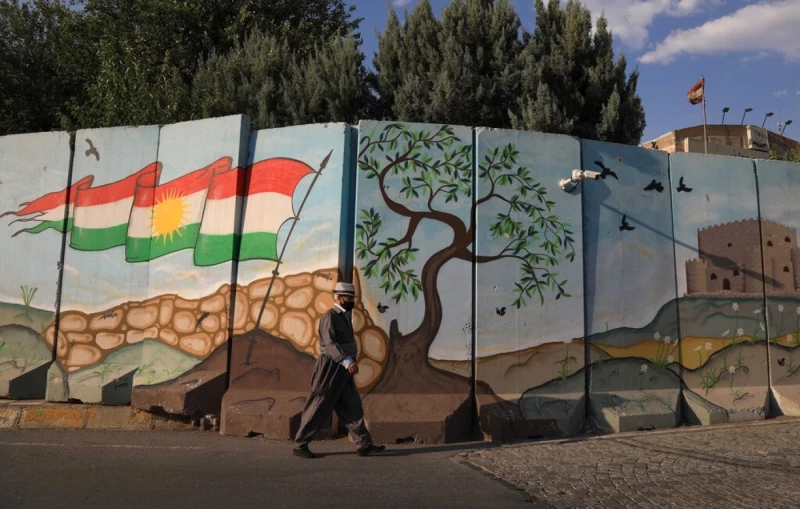
The fact of the matter is that, as it stands, the current situation tilts mostly toward surrender and defeat for the Kurds in Syria. It was the outcome of an alignment of the interests of the current Syrian government, Turkey, Gulf states, and America over Syria’s future course, and the Kurds simply did not possess the power to resist it. For the umpteenth time, the harsh realities of regional geopolitics, and their convergence with global dynamics, hit the Kurds hard in the face. The current reality in Syria is built on the demolition of the Kurdish-led de facto self-rule entity in Rojava/Northeast Syria. It is hard to sell this as an achievement, and, if anything, the tortured efforts by Kurdish officials such as Abdi to do so during media interviews demonstrate this.
However, this is not the end of the story. Syria is on the cusp of a significant transformation, and much now depends on President Ahmed al-Sharaa. He has an opportunity to reshape Syria’s inter-ethnic and inter-sectarian relations, although his record in Alawite and Druze areas gives ample reason for skepticism. This will free Syria from some of the core drivers of conflict that could otherwise haunt it time and again, removing some of the most potent obstacles to its long-term stability.
If the new Syria can enshrine three fundamental Kurdish rights in its constitutional and governing order, the SDF’s concessions could ultimately prove justified in the eyes of Kurds and pave the way for a more durable and legally recognized set of Kurdish gains unprecedented in Syria’s history.
First, any measurable success will depend on meaningful Kurdish linguistic rights. Kurdish children would need the right to Kurdish-language education in both public and private schools, not merely the inadequate three-hour arrangement proposed so far. Kurdish would also need to be allowed as a language of government in areas with Kurdish majorities or substantial Kurdish populations. This would mark a democratic departure from the oppressive past century under Arab nationalist rule and, frankly, a wholesome embrace of a not-so-distant past when ethnic and cultural diversity was accepted as part of the natural order of things in the region.
Second, meaningful local self-administration in Kurdish-majority areas would need to be guaranteed, particularly over civilian governance and day-to-day security, alongside proportional Kurdish participation in the governance of mixed areas of northern Syria.
Third, Kurds would need to be proportionally represented in national institutions in Damascus. The positions of presidential adviser and parliament member offered so far to senior SDF figures such as Abdi and Ilham Ahmed, as well as previous Kurdish parliamentary appointments, fall well short of demonstrating a commitment to meaningful Kurdish representation at the national level, given that Kurds are estimated to comprise at least 10 percent of Syria’s population.
The burden now rests largely with Sharaa. Despite his record, he may be uniquely positioned to deliver such a transformation. As a Sunni Arab, he has greater room to accommodate Kurdish rights without facing the kind of Sunni Arab backlash the Assad governments might have feared. And as an Islamist rather than an Arab nationalist, he should, at least in principle, have fewer ideological obstacles to recognizing ethnic equality and shedding the discriminatory legacy of Arab nationalism toward non-Arab minorities.
But the issue here is not only about Kurds. Beyond the SDF, how Sharaa treats Kurds as a people will have major implications for Syria’s future, his relationship with the Druze, and, by extension, Israel. Israel is the one external actor with the capacity to seriously destabilize Syria, and the Druze question has become an important part of Israel’s calculations toward the country.
The stakes of the Kurdish settlement, thus, extend far beyond their demographic weight. How Damascus treats the Kurds will be watched particularly closely by the Druze and other minorities as a test of what place they can expect in the new Syria.
And with Israel having emerged as an outside protector of Syria’s Druze and demonstrating its willingness to use military power on their behalf, Damascus’s management of intercommunal relations is no longer merely a question of domestic stability. Syria’s minority question has acquired a regional dimension, with potentially profound implications for Damascus’s relationship with Israel and, ultimately, for war and peace beyond Syria’s borders.
The views expressed in this article are those of the writer and do not necessarily represent the position of The New Region's editorial team.
 Facebook
 LinkedIn
 Telegram
 X
X