BAGHDAD, Iraq – A small armed network operating under the command of a senior Islamic Revolutionary Guard Corps (IRGC) commander carried out Thursday’s drone attack on Saudi Arabia’s East-West Pipeline, exposing a widening rift between the officer and commanders of Iraq’s key Iran-backed armed factions, three commanders told The New Region.
Three key Shiite armed factions operating under the banner of the Islamic Resistance in Iraq had no role in Thursday’s attack, the commanders of the Iran-backed armed factions said.
The Saudi foreign ministry announced on Friday evening that the East-West oil pipeline in the Riyadh and Medina regions was attacked by several drones launched from Iraqi territory, resulting in injuries and limited material damage.
Saudi Arabia said that, at the request of Iraqi Prime Minister Ali al-Zaidi, Baghdad would be given the opportunity “to take measures to prevent attacks launched from Iraqi territory against the Kingdom and neighboring countries.”
Zaidi subsequently ordered an urgent investigation to determine the drones’ launch site and identify those behind the attack. Within hours, investigators established that the drones targeting the Saudi pipeline had been launched from the al-Tayeb border area, 75 kilometers east of Amarah in Iraq’s southeastern Maysan province.
Zaidi dismissed the Maysan operations and police commanders, transferred the heads of security agencies in the province to their headquarters pending investigation over “security breaches that occurred in the province,” and ordered the closure of the Shib and Shalamcheh border crossings with Iran. Mandali border crossing was also closed, according to Iraq’s border ports authority.
Iraqi authorities on Sunday announced that the border will be fully reopened by Thursday.
Although the investigation has yet to identify the perpetrators, suspicion initially fell on factions of the Islamic Resistance in Iraq. The groups had threatened last month to attack Saudi Arabia in retaliation for the late-July US-Saudi airstrikes on Popular Mobilization Forces (PMF) positions across seven Iraqi provinces that killed and injured dozens.
The Islamic Resistance denied involvement on Saturday, saying that targeting vital facilities in Saudi Arabia was “an honor we do not claim,” and offered to participate in any government inquiry committee investigating the attack.
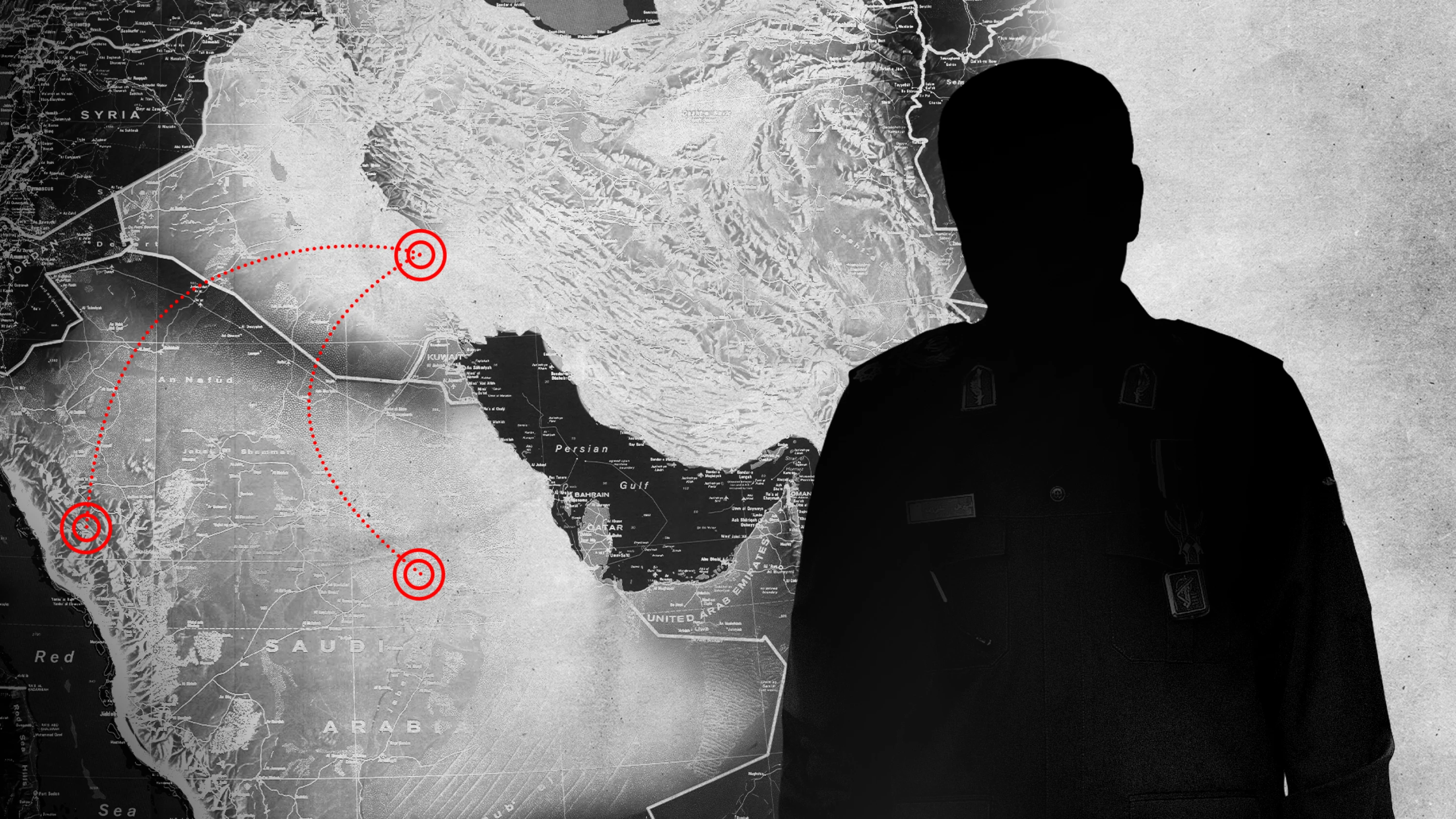
While the government investigation has yet to publicly identify those behind the attack, three Iran-backed Iraqi armed factions' commanders attributed it to a small armed group linked to a senior IRGC officer.
Established around seven months ago and operating separately from Iraq’s longstanding Iran-backed armed factions, the group is commanded by IRGC Colonel Hamed Abdollahi, known among Iraqi political and military circles as Haj Hamed, commanders told The New Region.
The group operates as a network of small cells in different areas, each consisting of several well-trained and experienced fighters drawn from the seven key Iran-backed armed factions, commanders said.
The cells report directly to Abdollahi and operate without coordination with or authorization from the commanders of their original factions.
“Hamid is going behind our backs. He formed a group that has begun acting independently,” a commander of an Iraqi Islamic Resistance faction said.
“The members of this group are a mixed bag of defectors, dissidents and double agents. They work directly with Hamid and are not under our command at all,” the commander said.
Regional targets, local operators
Since its establishment, the group has carried out five operations targeting the interests and facilities of regional countries, some involving multiple attacks on separate days, the commanders said.
Although the commanders did not specify exactly when the group was established, they listed the five operations they attributed to it in the order they occurred.
One commander said the group’s first operation targeted Erbil but did not identify the specific target or date. He said the second operation targeted Kharab al-Jir military base, also known as Rmeilan airport in Syria’s northeastern Hasaka countryside.
The airport was previously used by US forces and more recently by the Syrian army’s 60th Division. No casualties were reported.
That attack took place on March 23, when six drones targeted the base without causing casualties.
With the Erbil operation preceding the March 23 attack, two drone attacks on the United Arab Emirates (UAE) consulate building in the Kurdistan Region’s capital on March 10 and 14 emerge as the likely match. Neither attack was claimed by the known Iran-backed Iraqi factions.
Both operations triggered a backlash on social media and among politicians in Iraq, the UAE and Syria, prompting the three governments to move to contain tensions and prevent the incidents from developing into a diplomatic crisis.
The group then paused its operations, the commander said. The timeline reviewed by The New Region places that break at nearly two months. Operations resumed on May 17 when three drones targeted the Barakah nuclear power plant in the UAE, with one targeting a generator outside the facility in Al Dhafra, Abu Dhabi.
The Islamic Resistance in Iraq made no public claim of responsibility for the attack.
The group’s fourth operation came in two waves on July 27 and 28, when drones targeted oil facilities in Riyadh and Saudi Arabia’s Eastern Province. The factions of the Islamic Resistance in Iraq denied responsibility for the attacks despite widespread accusations that they were behind them.
The July attacks marked a turning point. On July 29, Saudi and US aircrafts struck PMF sites across seven Iraqi provinces, killing 20 PMF fighters and wounding 32 others.
The strikes came a day before a scheduled diplomatic visit to Riyadh by Zaidi, which was subsequently cancelled as tensions between Baghdad and Riyadh escalated.
The fallout also triggered one of the most serious crises between the Iraqi government and the Iran-backed armed factions. The three Islamic Resistance factions insisted on retaliating against Saudi Arabia for the killing of their fighters if the government failed to respond, while Baghdad sought to prevent further attacks and contain the escalation. The standoff brought the two sides close to a military confrontation.
Iraqi and Saudi authorities subsequently launched extensive investigations and exchanged intelligence over the attacks.
An intelligence report delivered to Zaidi last month blamed two Islamic Resistance factions for the May and July operations.
“[Harakat al-]Nujaba was accused of the attack on the UAE and Kataib Hezbollah of the attacks on Saudi Arabia,” a commander of the Islamic Resistance in Iraq said. “But we had nothing to do with either.”
Thursday’s attack was the group’s fifth and latest operation, the commander said.
A senior Iraqi security official who attended high-level meetings on the attack said officials viewed the operation as strategically significant, as Saudi Arabia relies on the East-West pipeline to export around 7 million barrels of oil daily while the Strait of Hormuz remains disrupted and Houthi forces have expanded their control over Yemen’s Red Sea coast, threatening another major route for Saudi and international oil shipments.
Although the attack caused limited damage to the pipeline, several people were reported injured. Its political repercussions were more serious, bringing relations between Baghdad and Riyadh close to another diplomatic crisis.
The attack also once again placed the factions of the Islamic Resistance in Iraq under suspicion despite their denial of involvement, threatening to further strain their already tense relationship with the government.
The pattern of the five operations, however, points to significant operational capabilities. The group repeatedly targeted sensitive sites across the region, in some cases at considerable distances from Iraq, requiring long-range drones, technical expertise and experienced operators.
Iraqi security officials and PMF commanders briefed on the latest developments in the investigation told The New Region that most, if not all, of the cross-border drone attacks carried out in the last three months were launched from areas along the Iraqi-Iranian border, increasing the distances the drones must travel to reach targets in Saudi Arabia and the UAE.
The choice of targets is also significant. The group repeatedly selected sites of such political, economic, or strategic importance that the countries targeted could hardly ignore the attacks, including a diplomatic mission, a nuclear power plant, military infrastructure, and critical oil facilities.
Drones were the sole weapon used in all five operations attributed to the group, commanders said. The faction commanders declined to disclose the drones’ types, origin, or specific capabilities, but described the resources available to the group as exceptional.
“The resources provided to this group are bigger than what is provided to all the key factions combined,” one faction commander said. “Hamed is mobilizing all available resources of the existing armed factions to support this group.”
Abdollahi’s activities have previously drawn scrutiny from both Saudi Arabia and the US.
Saudi Arabia designated him in October 2018 alongside other IRGC members, while the US Treasury Department had sanctioned him in October 2011, along with four other IRGC Qods Force officials, over an alleged plot to assassinate then-Saudi ambassador to the United States Adel al-Jubeir. The Treasury said Abdollahi coordinated aspects of the plot and oversaw other Qods Force officials involved in planning the operation. The UK followed suit in December 2020.
Clashing Interests
Abdollahi has overseen the military activities of Iran-affiliated armed factions in Iraq since 2020.
However, his influence over some of the country's established factions has weakened in recent years amid growing mistrust between the two sides, faction commanders told The New Region.
Thursday’s operation has brought into the open the deepening conflict between Abdollahi and commanders of the Iraqi factions he once oversaw, providing the clearest indication yet of a growing rupture within a network that had previously operated under a largely unified Iranian chain of influence.
Tensions between the two sides date back to December 2024, when Abdollahi reportedly asked the Iraqi armed factions to send fighters to Syria to defend the government of then-President Bashar al-Assad. The factions refused, instead insisting on withdrawing their fighters and families from Syria and returning them to Iraq, arguing that they had no interest in continuing to defend Assad.
Since then, relations between Abdollahi and the commanders of some of the key armed factions fluctuated, but the mistrust between them surfaced openly in March 2026, shortly after the assassination of Iran’s Supreme Leader Ayatollah Ali Khamenei.
Before he died in an Israeli airstrike in late February, Khamenei reportedly sent a message indicating that he did not back former Prime Minister Mohammed Shia al-Sudani for a second term as premier, sources told The New Region.
After Khamenei’s assassination, Abdollahi recommended that faction commanders back Sudani for a second term, a move that left them “shocked” because they believed it directly contradicted Khamenei’s position and risked causing splits within the factions. The commanders later found that backing Sudani was Abdollahi’s personal choice, two commanders said.
Since then, Abdollahi has lost the trust of most of the faction commanders, particularly those of the Islamic Resistance in Iraq, and disagreements between the two sides have become increasingly public.
“After that incident, we lost trust in the channels linking us to the IRGC command,” a commander said. “We began reviewing and scrutinizing everything. Every instruction and every piece of advice we received from Abdollahi became questionable.”
Abdollahi came close to being replaced shortly after Mojtaba Khamenei took over as Iran’s new supreme leader, the commanders said. The plan changed, however, following a broader reshuffle inside the IRGC after the killing of several of its senior commanders during the war.
Under the new arrangement, Abdollahi reports directly to commanders senior to Quds Force commander Brigadier General Esmail Qaani and no longer coordinates his decisions with Qaani or requires his approval.
The armed group Abdollahi established earlier this year falls under the same command structure, bypassing Qaani’s authority, the commanders said.
The new arrangement has only deepened the faction commanders’ concerns over how Abdollahi is using his expanded autonomy in Iraq, amid his growing involvement in Iraqi political maneuvering.
“Hamid is serving Iran’s national security interests, but we believe he is also playing games with some Iraqi politicians to serve his own interests,” a commander told The New Region.
 Facebook
 LinkedIn
 Telegram
 X
X