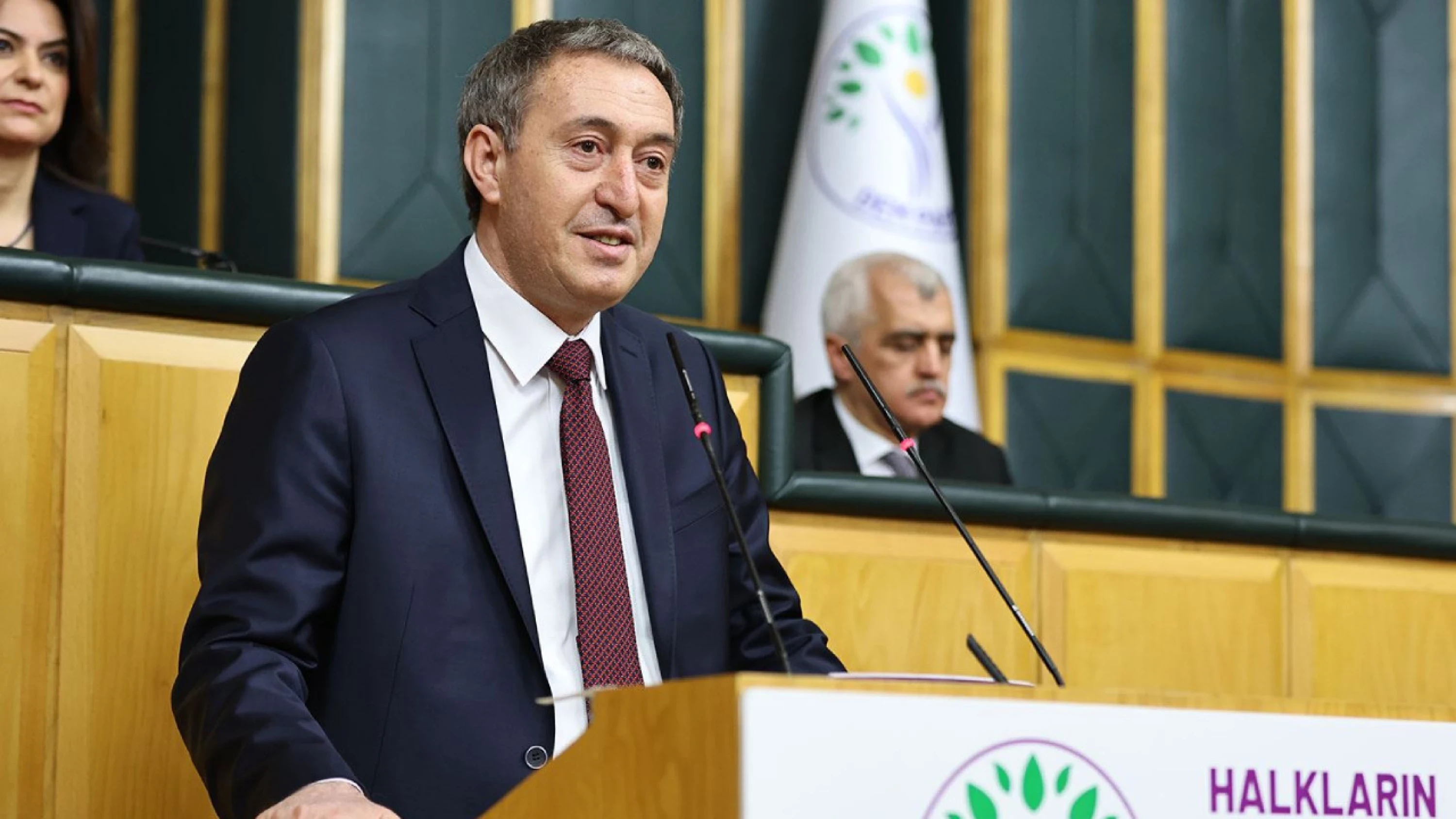
ERBIL, Kurdisran Region of Iraq - In an exclusive interview with The New Region, Peoples' Equality and Democracy Party (DEM Party) co-chair Tuncer Bakirhan spoke of his continued optimism regarding Turkey's ongoing peace process with the Kurdistan Workers' Party (PKK), terming the Kurdistan Region's mediatory role as “one of the guarantees of its success” and reiterating a call for the release of imprisoned Kurdish leader Selahattin Demirtas.
The pro-Kurdish party official visited Erbil to speak at the annual Middle East Research Institute (MERI) Forum, where he used his unique insights from the Turkish political scene to comment on the latest developments in the long-awaited reconciliation process.
The peace process was began in earnest in October 2024 by Devlet Bahceli, leader of the far-right Nationalist Movement Party (MHP), when he called on imprisoned PKK leader Abdullah Ocalan to address the Turkish parliament and call on his group to disarm in exchange for his conditional release, which the PKK did in May 2025.
Subsequently, the Kurdish militant group announced that it withdrew all its forces from Turkey, while having recently abandoned outposts in the Kurdistan Region close to the Turkish border.
Speaking to The New Region, Bakirhan thanked the Kurdistan Region for its major contributions to the peace process to date, highlighting the regional benefits for Kurds across the region a lasting peace would bring about. “Through you, I would like to express my sincere thanks once again,” he said.
“The Kurdistan Region is one of the key actors in the peace process. It can provide both political and diplomatic support for disarmament and democratization. The regional administration's active involvement in the process is one of the guarantees of its success,” Bakirhan said.
Bakirhan also stated that the process “could also benefit the Kurdistan Region, Iraq as a whole, and the wider region. It would be incomplete to view the peace process solely as an internal Turkish issue. We have never viewed it that way.”
“A successful resolution would directly affect Iraq's security architecture, Turkey-Iraq relations, and the Kurdistan Region's position in the region. More than four decades of conflict have largely extended into the Turkey-Iraq border area. Borders have become militarized, and the Kurdistan Region has constantly been caught up in regional security calculations. Now, for the first time, we are entering a period in which this dynamic could be reversed.”
READ MORE: Turkish state media confirms PKK withdrawal from four positions in Kurdistan Region
Bakirhan also told The New Region that a democratic resolution of the Kurdish question in Turkey could also change Ankara's approach to Erbil and Sulaimani, observing that relations centered on the perception of a "security threat" could evolve into a more enduring economic, social, and political partnership.
While Erbil has maintained strong diplomatic and political ties even before the peace process, Sulaimani has recently improved relations with Ankara amid the diplomatic peace dividend.
“Trade, energy, and transport links between Turkey and the Kurdish geography (regions) could be strengthened if Turkey resolves the Kurdish question through peaceful and democratic means,” Bakirhan stated.
“Major projects such as Iraq's Development Road can only realize their full potential through stable Turkish-Kurdish relations. Issues that will shape the region's future, including water, energy, and trade, could increasingly be addressed through cooperation.”
“In short, by establishing a solid foundation for shared interests and mutual gains among all parties, peace could have major positive implications for stability and the development of a democratic order in the Middle East,” he concluded.
Selahattin Demirtas
The DEM Party co-chair also spoke of the importance of securing the release of imprisoned Kurdish politician Selahattin Demirtas, who has been jailed since 2016, as a means of advancing the peace process.
“Selahattin Demirtas has been subjected to grave injustice for years,” Bakirhan stated. “The European Court of Human Rights rulings are clear, as are the decisions issued under domestic law. His release is not a gesture, a sign of goodwill, or a reward to be granted at the end of the process. It is a legal obligation.”
READ MORE: Demirtas handed another jail term over ‘insulting’ Erdogan charges
Demirtas, the former co-chair of Turkey's pro-Kurdish Peoples’ Democratic Party (HDP), a precursor to the DEM Party, has remained in jail since his initial arrest amid a crackdown on the party. In November last year, Bahceli said that releasing Demirtas “will be beneficial to Turkey.”
“As a party, we are making every effort to end the unlawful treatment of Demirtas, Figen Yuksekdag [a former HDP co-chair], and our other colleagues. We will continue to raise this issue and work toward that goal,” Bakirhan concluded.
Optimism
Despite the continued imprisonment of his colleagues, Bakirhan remains optimistic about the peace process. “I want to make this very clear: optimism does not mean seeing what is happening through rose-colored glasses. It means refusing to lose the will to believe that a different life is possible,” he said.
Kurdistan Region President Nechirvan Barzani, during the MERI Forum on Monday, also underlined that the slow pace of the peace process is understandable. “We are speaking of forty years of conflict, forty years of war, forty years of misunderstanding and denial… We cannot expect all of these problems to be resolved overnight.”
“Peace is, in a way, precisely that. It is not just a document signed one day or a photograph taken in a room,” Bakirhan added. “It means people no longer being afraid when they leave their homes in the morning, mothers being able to sleep without wondering which mountain or prison their sons are in, and young people no longer planning their lives around the possibility of war.”
“That is why, for me, peace is as much a matter of life as it is a political choice. The same is true for our party. Of course, processes can become exhausting, reach deadlock, and sometimes see hope fade. But those are precisely the moments when we must insist on peace.
“I remain optimistic, and as long as there is even the slightest sign of progress, I will continue to be optimistic about peace,” he added.
The Kurdish politician stated that the success of the peace process will bring an end to various political and economic rent-seeking networks that have emerged during more than 50 years of conflict.
At the MERI Forum on Tuesday, Bakirhan also stated that if the people who spent $3 trillion to prevent Kurds from speaking their mother tongue had instead spent that money on Turkey’s economy, prosperity, and infrastructure, we would be looking at a very different Turkey today.
Bakirhan also said there are other obstacles to the peace process, such as domestic and foreign actors opposed to the process.
“It will also bring about significant changes in regional power dynamics. For this reason, the main obstacles to the peace process are efforts by domestic and foreign actors to organize politically against it. This is the most fundamental structural obstacle facing the process,” he added.
“In addition, the language used against peace and the Kurdish people by mainstream media in Turkey, including outlets supportive of both the government and the main opposition, has the potential to create further obstacles to the process.”
Bakirhan also stated that both sides need to take reciprocal steps to ensure that the ongoing process continues successfully.
“Unless this requirement is met, the process could suffer. In this regard, the state and the government must act more quickly and take steps to build trust.”
 Facebook
 LinkedIn
 Telegram
 X
X