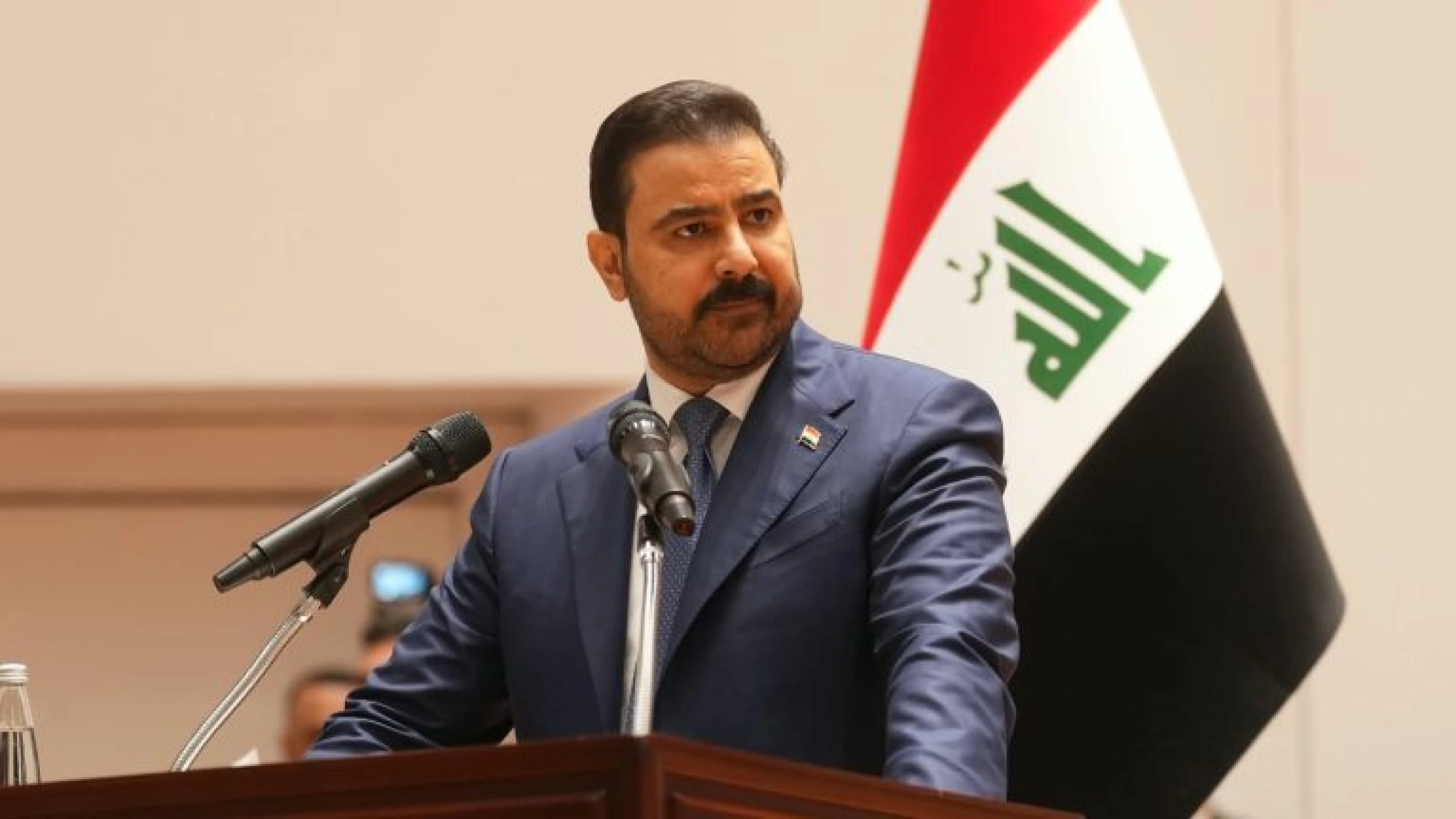
Iraq’s government formation was nearly completed on October 15, as Prime Minister Ali al-Zaidi secured parliamentary approval for ten ministers, one minister of state, and three deputy prime ministers. Two positions remain unfilled: a fourth deputy premiership allocated to the Kurdistan Democratic Party (KDP) and the Ministry of Migration and Displacement. The latter remains contested between the Christian Soyana parliamentary bloc, allied with the KDP, and the Iran-backed Babylon Movement, another Christian bloc in the parliament.
Cabinet formation in most countries might be strictly a domestic affair, but not in Iraq. For the past 23 years, it has also served as an indication of the extent of American and Iranian influence over the country’s political direction.
The process began on May 14, when Zaidi secured parliamentary approval for 14 ministers. However, key portfolios, including interior and defense, remained vacant. Following five months of political wrangling, Zaidi finally managed to put forward another list of candidates.
Several appointments across both rounds were noteworthy. These included Mustafa Sanad, a former MP with alleged connections to Kata’ib Hezbollah (KH), as communications minister; Ali Abdul Hadi al-Dakhili, reportedly associated with Kata’ib Sayyid al-Shuhada (KSS), as tourism minister; and Laith al-Khazali, a senior figure in Asa’ib Ahl al-Haq (AAH), as deputy prime minister. Earlier, in May, senior Asa’ib leader Adnan Faihan was appointed deputy parliamentary speaker.
The significance of these appointments lies in the US designations of several Iran-backed factions and their leaders. KH, KSS, and AAH are among six Iran-backed armed factions designated as Foreign Terrorist Organizations by the US State Department and as Specially Designated Global Terrorists under US Treasury sanctions.
The appointment of figures affiliated with or associated with these groups came despite months of American direct and indirect pressure to prevent individuals linked to Iran-backed armed factions from joining the new government. These appointments therefore raise an important question about Washington’s approach to government formation in Baghdad and whether it signals a shift in US policy.
One possible explanation is the growing involvement of Ambassador Tom Barrack, who serves as US special presidential envoy to Iraq and Syria, as well as ambassador to Turkey. Barrack visited Baghdad in November 2025, although that visit appeared primarily concerned with Syria and Syrian-Iraqi relations. He returned again in February 2026, following tensions between Washington and Baghdad over Nouri al-Maliki’s nomination for prime minister. Barrack’s formal appointment on May 31 as Iraq envoy confirmed a role he had effectively been playing for months, particularly in the absence of a US ambassador since Alina Romanowski’s departure in December 2024.
Although no formal policy change has been announced, Washington’s approach appears to have evolved in ways that resemble its policy toward Syria under Barrack’s leadership: engaging and accommodating former or existing adversaries in the hope of inducing changes in their behavior.
Such an approach has a certain diplomatic logic. Engagement can create incentives for moderation and potentially reduce the costs of confrontation. But its effectiveness depends on whether the actors concerned have genuine reasons to change their behavior and whether Washington can enforce the conditions attached to accommodation, assuming there is actually any.
Two calculations may underpin this emerging approach. First is the assumption that Iran-backed armed factions can be divided into pragmatic and hard-line camps. Through a combination of carrots and sticks, Washington may hope to encourage the former to moderate their behavior and abandon activities threatening American interests, although such restraint might not necessarily extend to US allies and partners. The remaining factions could then be isolated and subjected to more targeted pressure, whether through kinetic military action or economic sanctions, or a combination of both.
Second, while Washington and Tehran remain locked in military and economic confrontation, the United States may ultimately hope to resolve their differences through some form of grand bargain. Accommodating certain Iran-backed groups in Iraq could signal to Tehran that Washington recognizes its regional interests and is prepared to accommodate some of them. Such an arrangement could potentially leave Iran’s regional proxy network, and perhaps even its missile program, outside the central bargain, making the nuclear program the principal issue of contention.
Syria appears to offer a blueprint for Washington’s new approach to Iraq, given warm ties there with President Ahmed al-Sharaa who was once designated as a terrorist by the US. But Iraq and Syria are fundamentally different cases. In Syria, the Sunni-led government enjoys support from important US regional allies, particularly Turkey and the Gulf states and it does not currently pose a threat to American interests.
Iraq presents a different reality. Iran retains considerable influence over the Iraqi state and has pursued a project of state capture for nearly two decades, particularly since the emergence of the Islamic State group (ISIS) in 2014. Bringing figures associated with Iran-backed factions into government may provide these groups with much-needed international legitimacy. Rather than undermining Tehran’s influence, such accommodation might actually reinforce, consolidate, and legitimize it. Iran and its allied armed factions operate on a different timeframe than the United States, exercising greater strategic patience.
There is also a calculation among some Iraqi political actors that American pressure may eventually fade, particularly if a new administration or party takes office in Washington in 2029. They appear to sense a lack of consensus in Washington’s approach toward Iraq and seek to capitalize on it. They also seem to expect that a future US administration will be less committed to confronting Iran and its proxies in Iraq altogether, with limited interest or political bandwidth to sustain pressure amid broader challenges to America’s global position. Whether that scenario materializes remains uncertain. But the underlying equation in Iraq is unlikely to change fundamentally without a major transformation in Iran itself, such as regime collapse, for which there is currently no immediate indication.
June 2027, the new deadline for disarming Iraq’s armed factions, could prove decisive. By then, we may have a clearer indication of whether Washington intends to roll back the influence of at least some Iran-backed factions or has largely abandoned that objective in favor of inducing behavioral change through economic and military pressure.
Amid all this, the apparent shift in US policy is likely to affect regional perceptions of Washington, whether those perceptions are entirely justified or not. It risks undermining confidence among longstanding US allies and partners in Iraq and across the wider region.
Some figures within Iraq’s Shiite political leadership appear to sense a retreat from Washington’s earlier tough rhetoric. Consequently, calls for a Syria-style recentralization of state authority in Iraq appear to be gaining ground. On October 15, Faiq Zidan, head of Iraq’s Supreme Judicial Council, called for amending contentious provisions of the constitution, citing problems involving parliamentary majorities, presidential elections, and the designation of the largest parliamentary bloc.
Although constitutional reform does not inherently entail centralization, there is a possibility that amendments could be used to further concentrate power in Baghdad and, consequently, strengthen the Shiite political establishment, within which Iran-aligned forces hold the dominant position. Whether Washington supports such ambitions remains unclear. Yet there is a perception in Iraq that influential circles within the US administration favor such an outcome—again regardless of whether that perception is accurate.
For now, Iraq and the United States appear to be entering a new phase in their relationship, and we are witnessing a significant redefinition of friends and foes in US policy toward the region. But despite hopes to the contrary, the current policy may not necessarily bring Iraq greater stability or move it closer to Washington in the long run, notwithstanding the considerable leverage Washington continues to possess over Baghdad, particularly in the economic and financial spheres.
The views expressed in this article are those of the writer and do not necessarily represent the position of The New Region's editorial team.
 Facebook
 LinkedIn
 Telegram
 X