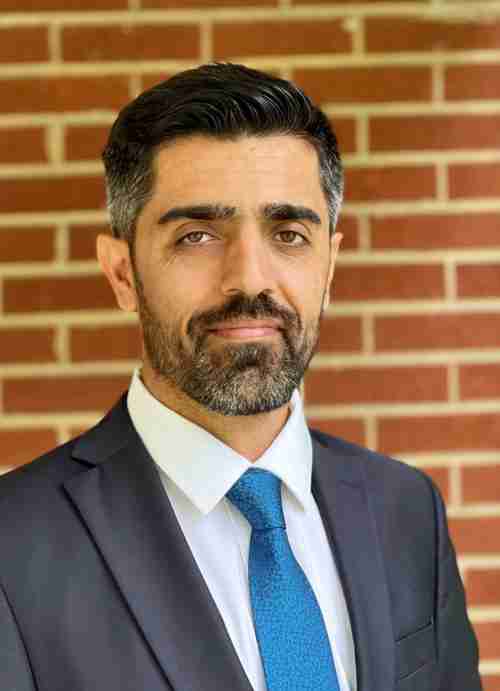
On the latest episode of The New Region’s GeoSpace podcast, host Mohammed A. Salih spoke with Lahib Higel, the International Crisis Group's deputy director for the Middle East and North Africa, to discuss Iraqi Prime Minister Ali al-Zaidi's militia disarmament amid the Jurf al-Nasr standoff with Kataib Hezbollah, as well as its implications for the Kurdistan Region and the current US approach to Baghdad and Erbil.
Higel, who recently visited Iraq, began by describing the popular mood she perceived regarding Zaidi's drive to restrict weapons to the hands of the state, one which she observed to be "quite excited about this prospect."
"A lot of the armed groups that have maintained, sort of, autonomous command structures, economic activities, etc, are seen as a liability to the state's proper function," she explained. "And then within the government and within the political establishment, I think there is also some optimism that this might work out."
"The benefit that this prime minister has, in contrast to others, is that, essentially the whole Shiite Coordination Framework, which, sort of makes up the main governing coalition behind him is on board with the overall objective. And that objective is that the state should control all of its territory, including Jurf al-Sakhar [Nasr], which has been outside of state control for the past 12 years."
Touching on the situation, which has seen Zaidi pledge to wrest control of Jurf al-Nasr from the pro-Iran Kataib Hezbollah amid an oil smuggling scandal, Higel said, "Of course, it is about rehabilitating a geographical area of the country that has not been under the authority of the state."
When asked by Salih about the June 2027 deadline for the disarmament of the armed factions, she expressed her doubt that the groups in question will lay down their arms while the US and Israel still mull another prospective military conflict with Iran.
"If there was an understanding between the US and Iran tomorrow, I think there's a much greater chance for Iraq and the government to see through the process by June 30th."
The pair also spoke of the current Iraqi political situation's implications for the Kurdistan Region, focusing on oil facilities in disputed areas amid ongoing internal political discord between the Region's ruling parties.
"In the case of the Kurdistan Region, there are still issues that remain in terms of the oil revenues and how they are distributed between the federal government and the region," she explained.
When asked about US Special Envoy Tom Barrack's approch toward the Region, she asserted that she does not believe that he seeks to dismantle Iraq's federal system, but is "more interested in is seeing Baghdad and Erbil resolving its issues without the US having to intervene."
"We're in a phase now where the US has started to disengage with Iraq, certainly militarily, as we've seen, they've withdrawn. They're also not as interested in retaining the Kurdistan Region as their main hub to, sort of advance its Iraq policy. They're doing it through both Erbil and Baghdad."
She concluded that the current US approach is an opportunity for the federal government and Kurdistan Regional Government (KRG) "to get their act together, and to start resolving these issues on their own, because they're perennial. They come every year, or every four years, when there's a new government installed."
"They need to find a better way at working with each other. Now, of course, the divisions within the Region right now are not helping, but I think, you know, on both sides, that should really be the objective. You shouldn't need an external power broker to resolve domestic issues."
 Facebook
 LinkedIn
 Telegram
 X