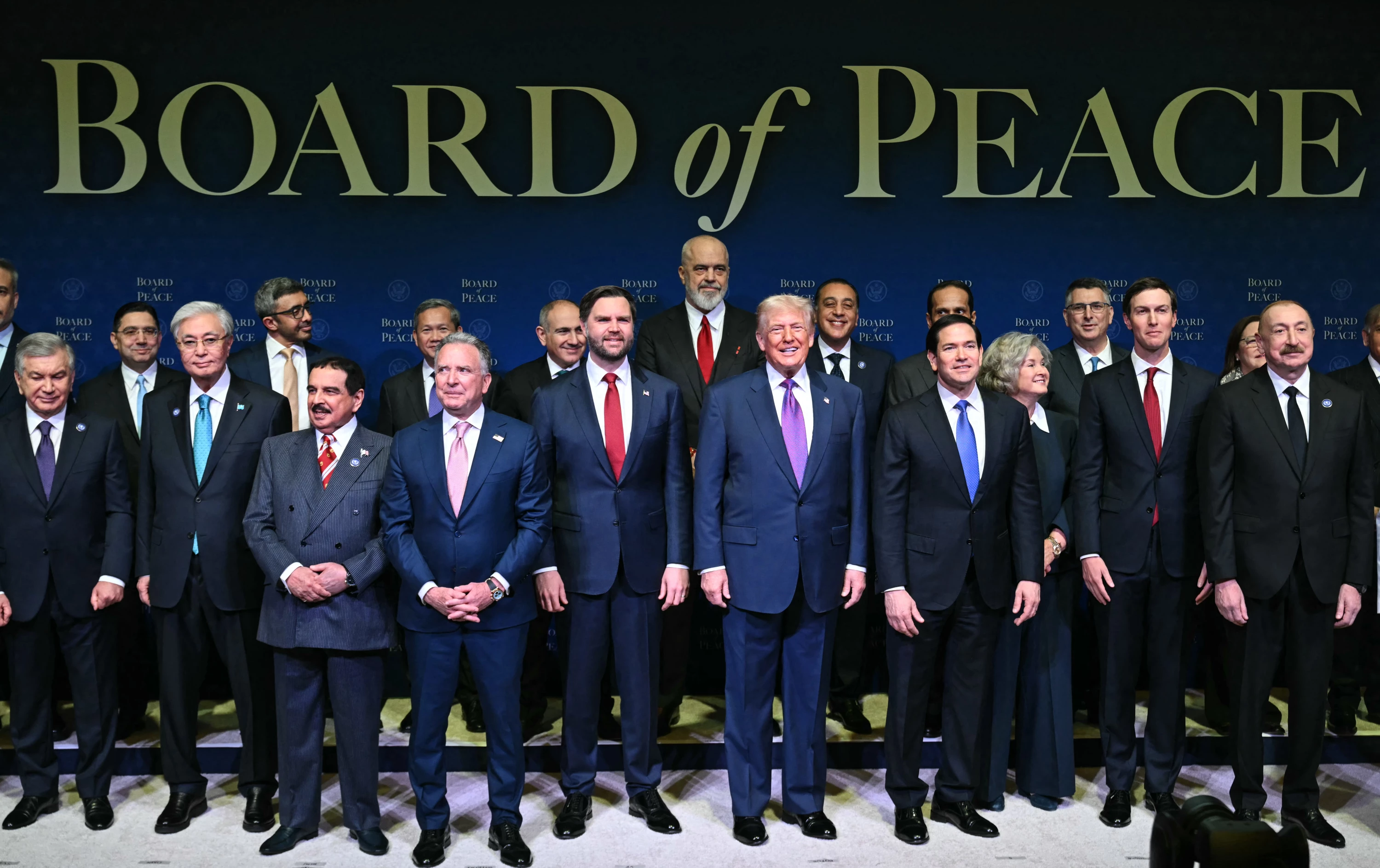
DUBAI, United Arab Emirates - The inaugural Board of Peace meeting kicked off in Washington on Thursday, seeing more details being unveiled regarding reconstruction efforts in Gaza, the deployment of a stabilization force to the Palestinian territory, with five countries committing troops to the body, and the establishment of a new police force separate to Hamas.
US President Donald Trump chaired the first meeting of the Board, which was established to oversee Gaza’s reconstruction but whose mandate has broadened to include conflict resolution efforts more widely.
Speaking at the opening session, Trump said Gaza “is no longer a hub of extremism and terrorism” and added that he does not believe it will be necessary to send US combat troops to the territory.
“I don’t think it will be necessary to send soldiers to fight,” Trump said. He added that “it seems Hamas will get rid of its weapons, but we have to make sure of that,” warning that if the group fails to meet its commitments under the Gaza agreement, “we will deal with it harshly.”
A ceasefire in October between Israel and the Hamas militant group brought an end to the former's brutal genocide in the Gaza Strip that saw over 75,000 Palestinians be killed, sparking international outcry and leading many traditional Israeli allies to speak out against its actions.
The agreement saw Hamas return the bodies of Israeli hostages and accede to a proposed framework that would result in control of the Strip being transferred to a new, non-Hamas-affiliated Palestinian security force.
Trump said Egypt would provide training and support to a “trusted Palestinian force,” stressing that the United States is committed to ensuring Gaza is “well governed.” He described the Board of Peace as one of his administration’s key achievements, alongside ending several wars, and said the cost of war far exceeds the cost of peace.
International stabilization force
Jasper Jeffers, commander of the proposed International Security Force (ISF) for Gaza, told the summit that five countries have pledged to send troops to serve in the stabilization mission: Indonesia, Morocco, Kazakhstan, Kosovo, and Albania.
He said Indonesia has accepted the position of deputy commander of the force. Egypt and Jordan, in turn, have pledged to train police personnel.
“I am very pleased to announce that the first five countries have committed to sending forces to serve within the International Stabilization Force,” Jeffers said.
Indonesian President Prabowo Subianto said his country would contribute “8,000 soldiers or more” to the mission. Kazakhstan’s President Kassym-Jomart Tokayev said his country would deploy military units, including medical units, to the new international force.
Morocco’s Foreign Minister Nasser Bourita said Rabat is ready to deploy police officers to Gaza, marking the first confirmed participation of an Arab League country in the stabilization force.
Turkish Foreign Minister Hakan Fidan, meanwhile, expressed Ankara's willingness to participate in the ISF, though Israel has long balked at the notion of any Turkish participation over the country's perceived anti-Israel bias.
Separately, Nikolay Mladenov, the Board of Peace’s high representative for Gaza, said 2,000 Palestinians have applied to join a new transitional Palestinian police force, and recruitment has begun. He stressed that “there is no option but to disarm all factions in Gaza.”
Reconstruction funding
During the meeting, Kuwait, Saudi Arabia, and Qatar each pledged $1 billion for Gaza’s reconstruction, while the United Arab Emirates pledged $1.2 billion. Trump, meanwhile, announced that the US will be providing $10 billion to the Board of Peace as a whole.
The European Union participated in the summit as an observer.
The gathering comes as the international community seeks to stabilize Gaza after the devastating war that erupted following Hamas’ unprecedented October 7, 2023, attack on Israel. Discussions focused on reconstruction, security arrangements, and long-term governance of the enclave.
Trump said “most world leaders” agreed to join the Board of Peace, though he added that “there are leaders we do not want participating.”
“The situation in Gaza is complicated,” he said. “We are working together to ensure a better future for the people of Gaza, the Middle East, and the world as a whole.”
 Facebook
 LinkedIn
 Telegram
 X
X